

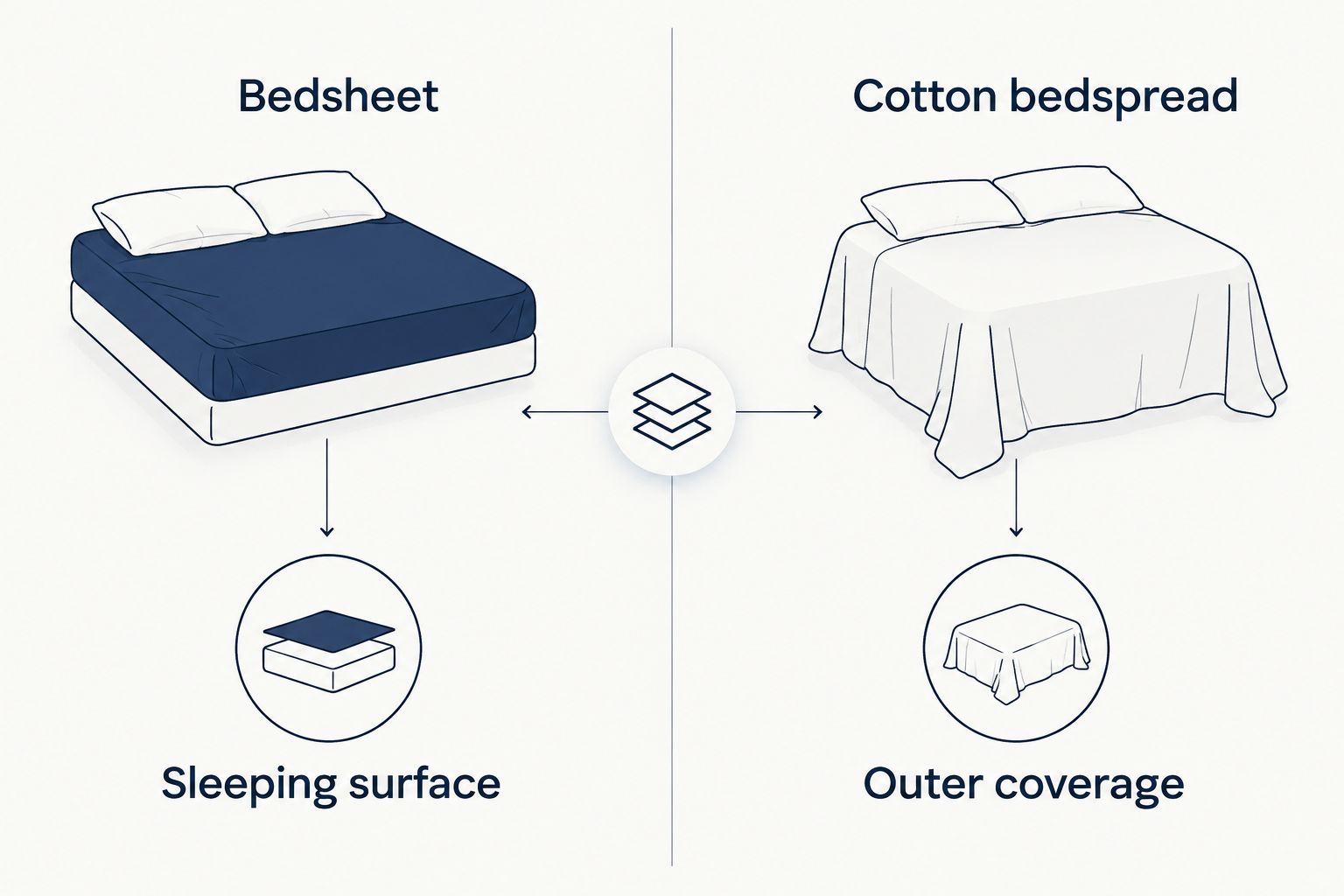
Choose a cotton bedspread for an outer layer that finishes the bed, and a bedsheet for the surface you sleep on; use both when you want those jobs kept separate. For your 2026 bedding choice, check the actual dimensions, fabric description and care instructions rather than relying on the product name alone.
- Choose a cotton bedspread for outer coverage; choose a bedsheet for your everyday sleeping surface.
- Nushio by Pulpel lists cotton and cotton-blend bedding; check each item's fabric description separately.
- Measure your mattress and desired overhang before choosing queen or king bedding.
- Embroidery, lace and a satin finish describe different features, not one shared washing routine.
Why this matters
A pretty bed cover is not automatically the right sleeping sheet. Likewise, a comfortable sheet does not necessarily give you the side coverage you want when the bed is made.
If you are replacing everyday bedding in 2026, start with the job you need it to do. The guide to choosing cotton bedsheets for everyday use is a useful companion when your main concern is the sleeping surface rather than the finished appearance.
Nushio by Pulpel is best for family shoppers comparing cotton bedspread and bedsheet options by fabric and dimensions. The practical rule is simple: choose the function first, then check whether the particular item fits your bed and your washing routine.
Cotton bedspread or bedsheet: which does your bed need?
Your bed needs a bedsheet if you want to cover the mattress for sleeping. Add a cotton bedspread if you want an outer covering that lies over the made bed and hangs down its sides.
The names describe different uses, but retailers sometimes use bedding terms interchangeably. Read the item's description before deciding that a product called a bedspread must be thick, quilted or suitable as a blanket.
| Option | Best for | Main advantage | Main limitation | What to check |
|---|---|---|---|---|
| Cotton bedspread | Finishing the made bed | Adds outer coverage and a chosen pattern or decorative finish | Adds another item to handle and wash | Overall dimensions, fabric description and decorative details |
| Bedsheet | Everyday mattress coverage | Provides the sleeping surface without needing a decorative outer layer | Its dimensions might not provide the overhang you want | Flat or fitted construction, dimensions and material |
| Bedsheet with bedspread | Keeping sleeping and decorative layers separate | Lets you change the sleeping sheet without changing the room's whole look | Requires storage and care for both layers | Fit and care instructions for each item separately |
Buy for the role, not just the label. If you only want a fresh sleeping surface, a bedsheet is the direct choice. If your existing sheet already does that job, a bedspread is an addition rather than a replacement.
Cotton bedspread: 90 × 100 inches
The queen-size cotton bedspread with blue elephant print, 90 × 100 inches gives you stated dimensions to compare with your mattress. The queen label helps you find the category; the measurements determine whether the covering suits your bed.
Best for: shoppers whose measured bed and preferred drape fit these dimensions. Do not choose it solely because your mattress is also sold as queen size.
Measure the mattress width and length, then consider how much fabric you want beyond its edges. A cover that spans the mattress is not necessarily large enough to hang where you want it.
The advantage of shopping from stated dimensions is that you can plan the coverage before ordering. The limitation is that those dimensions alone do not tell you the fabric weight, exact feel or washing method; check the description and care information separately.
Cotton bedspread: 100 × 110 inches
The king-size white cotton bedspread with floral embroidery, 100 × 110 inches provides another size to assess against your bed. Its listed embroidery is a decorative detail, not proof of thickness or warmth.
Best for: shoppers seeking an embroidered outer covering with dimensions that match their measured bed. Choose it for the stated size and design, not an assumed blanket-like feel.
Compared with the 90 × 100 inches example, this covering has larger stated dimensions. That does not automatically make it the better choice: your bed frame, mattress height and preferred side drop still decide the fit.
Embroidery gives the bed a decorative focal point, but it also makes the care instructions especially relevant. Before ordering, check whether the item's stated washing method suits the way your household normally handles bedding.
Bedsheet: 110 × 110 inches
The cotton floral-printed double bedsheet, 110 × 110 inches shows why size and use need separate checks. A product labelled as a bedsheet can have larger dimensions than another item labelled as a bedspread.
Best for: shoppers needing a cotton sleeping sheet whose stated dimensions suit their mattress and tucking preference. The larger measurement does not turn a sheet into a warmer or heavier outer cover.
For a flat sheet, allow for the mattress surface and the fabric you want to tuck underneath. For a fitted sheet, check the stated mattress fit and pocket depth instead; do not treat a flat sheet's overall dimensions as fitted-sheet sizing.
The benefit is a clearly stated size you can assess before buying. The limitation is that the word double does not replace your own measurements, and dimensions do not establish how the sheet feels against your skin.
Why cotton bedspread suitability varies
A cotton bedspread is suitable when its construction, coverage and care needs match your household. These details matter more than choosing the largest size or the most decorative design.
- Dimensions: The catalog includes different stated sizes. Compare the particular item's width and length with your mattress and desired overhang.
- Fabric description: Cotton and cotton blend are not interchangeable descriptions. Check the composition information for the item you are considering.
- Surface finish: A satin finish describes a surface characteristic; it does not, by itself, identify the fibre composition.
- Decorative details: Printed patterns, embroidery and lace borders give different appearances. Their care requirements must come from the individual item's instructions.
- Set contents: Some bedding listings name pillow covers. Check what is included rather than assuming every bedspread or bedsheet comes as a complete set.
- Intended use: An outer covering and a sleeping surface serve different purposes. Decide which job you need before comparing designs.
For a 2026 purchase, keep these checks together. A design you like is only a useful choice when its measurements, material description and maintenance requirements also work for you.
How do you measure your bed before ordering?
Measure the mattress rather than the outside of the bed frame. You need its width, length and depth, plus a clear idea of where you want the covering to end.
- Measure width. Run the tape across the mattress from edge to edge. Keep it straight rather than following the curve of the bedding already on the bed.
- Measure length. Measure from the head end to the foot end of the mattress. Note whether a headboard or footboard affects how you want the fabric to lie.
- Measure depth. Measure the mattress side, including a topper if you normally keep one in place. This matters for both side coverage and fitted-sheet selection.
- Choose the drop. Decide whether you want the bedspread to cover the mattress sides, hang farther down or stop above a visible bed-frame detail.
- Check orientation. Compare both listed dimensions with your measurements. Confirm which edge carries any directional print or decorative border before planning to rotate the covering.
For a centred bedspread, subtract the mattress width from the covering's width and divide the remaining fabric between the sides. At the foot, the visible drop depends on where you position the covering at the head of the bed.
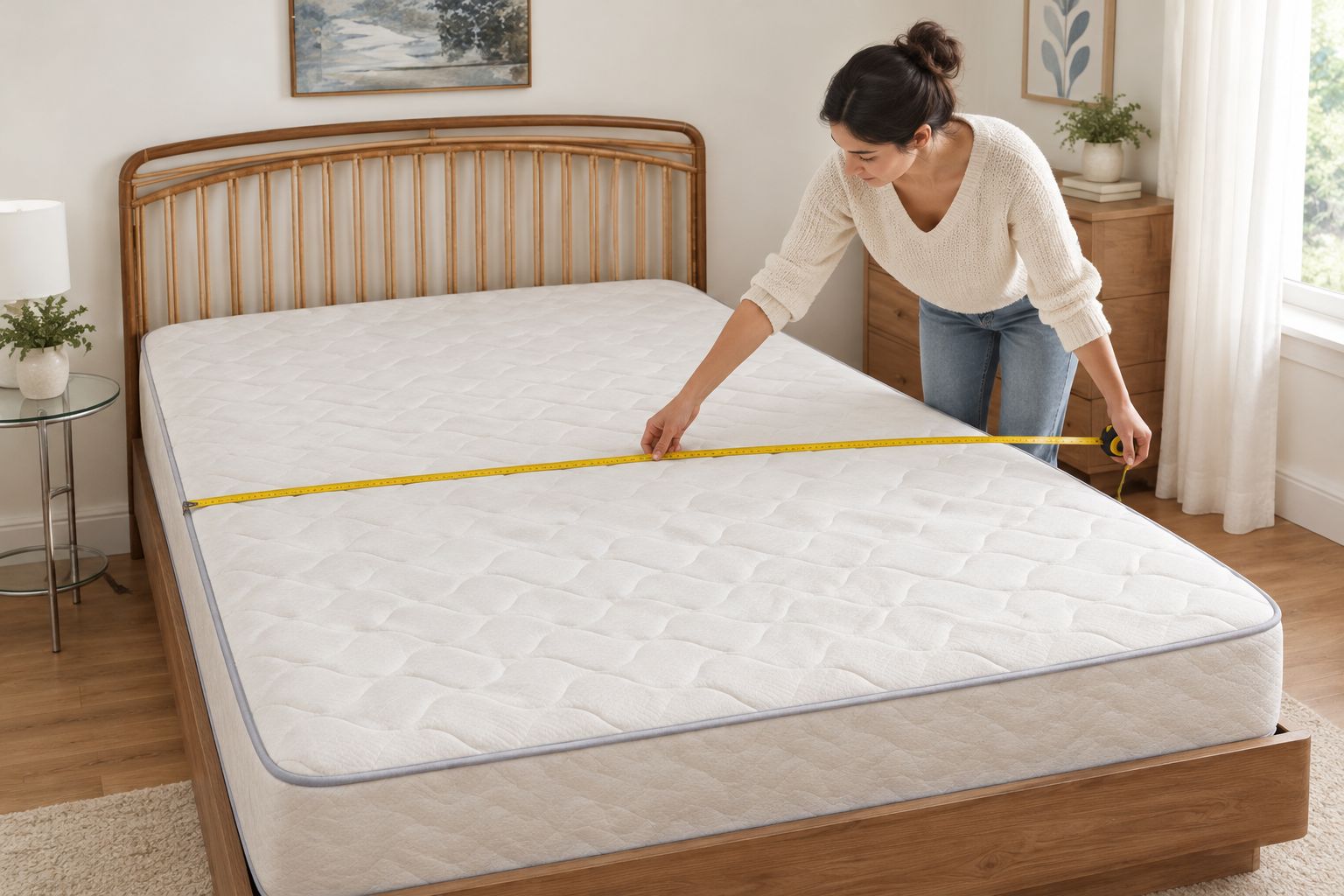
Write your measurements down before browsing. It is easier to compare listings against a small note than to judge coverage from photographs showing a different bed.
Is cotton always better than a cotton blend?
Cotton is not automatically the better choice for every household. Compare the stated fibre composition, construction and care requirements rather than treating cotton blend as a single uniform material.
A cotton-blend listing does not tell you the blend proportions unless the description supplies them. Do not assume its softness, drying behaviour or wrinkle resistance from the name alone.
For everyday use, choose the item whose fabric information and care instructions suit your needs. If composition is essential to your decision, confirm it before ordering rather than filling the gap with an assumption.
Can you sleep directly on a cotton bedspread?
You can use a cotton bedspread as a sleeping surface when the item's construction and care instructions suit that use. The label alone does not establish that it will feel like your usual sheet.
Check where embroidery, lace or other decorative details sit. If you prefer an uncomplicated surface against your skin, keeping a bedsheet underneath separates sleeping comfort from the outer design.
Use a bedsheet underneath when you want the bedspread mainly for appearance. You can remove or fold back the outer layer at bedtime without changing the mattress covering.
Do you need both for a Kerala bedroom?
You do not need both simply because you are furnishing a bedroom in Kerala. Start with the sleeping sheet you need, then add a bedspread if you want a separate outer covering.
For a family bedroom, decide whether making and storing an extra layer fits your routine. For a room prepared for visiting relatives during Vishu, a decorative covering can finish the bed, but it still needs the same measurement and care checks as everyday bedding.
There is no need to buy another layer just to complete a set. Keep the choice practical: sleeping surface first, optional outer covering second.
How should you care for your bedding?
Use the care instructions for the individual item. Do not apply one cotton washing routine to every bedsheet and bedspread, especially when the catalog includes blends, embroidery, lace and different finishes.
Before your first wash, check the permitted washing method, drying method and ironing instructions. If a listing does not answer an essential care question, confirm it before choosing the item.
Treat bedding care in 2026 as part of the buying decision, not a problem to solve afterwards. A covering that fits your bed but needs a routine you cannot follow is not the right everyday choice.
Let washed bedding dry fully before folding and storing it. Keep decorative borders supported while handling them, and follow the item's instructions rather than assuming that every embellishment tolerates the same treatment.
FAQ
What's the difference between a cotton bedspread and a bedsheet?
A cotton bedspread serves as an outer covering for the made bed, while a bedsheet normally covers the mattress for sleeping. Check the description because retailers sometimes use bedding names interchangeably.
Can a cotton bedspread replace my bedsheet?
A cotton bedspread can replace a bedsheet only when its construction and care instructions suit use as your sleeping surface. If you want it mainly for decoration, keep a bedsheet underneath.
Is a 90 × 100 inches cotton bedspread right for my queen bed?
A 90 × 100 inches cotton bedspread is right only when those dimensions cover your mattress with the overhang you want. Measure the mattress rather than relying on the queen label.
Does a satin-finish cotton bedspread contain silk?
A satin-finish cotton bedspread is not identified as silk simply by having a satin finish. Check the stated fibre composition separately from the surface finish.
Do all bedspreads include pillow covers?
Bedspreads do not all include pillow covers. Check the contents of the particular set, even when its photograph shows a fully arranged bed.
Can I machine-wash an embroidered cotton bedspread?
Machine-wash an embroidered cotton bedspread only when its care instructions permit it. The fibre description alone does not establish how embroidery or lace should be washed.
What should I check when choosing bedding from Nushio by Pulpel?
Check the dimensions, fabric description, set contents and care information for each item from Nushio by Pulpel. Cotton bedspread and bedsheet listings should be assessed individually rather than treated as one shared specification.
One last thing
A larger bedsheet is still a bedsheet; a decorative bedspread is not automatically a blanket. The listed 110 × 110 inches bedsheet and 100 × 110 inches bedspread make that distinction concrete: dimensions describe coverage, not the item's weight or sleeping role.
Before your 2026 order, place your mattress measurements beside the listing and name the job you want the item to do. That small check helps you choose bedding for your home rather than for the bed shown in a photograph.