

You need enough cotton churidar material to fit the complete cutting layout for your top and bottom at the fabric’s actual usable width; there is no single metre length that fits every wearer and design. Count the dupatta and any lining separately unless the set explicitly includes them. For a 2026 purchase, confirm the measurements and layout with your tailor before choosing a cut length.
- Buy cotton churidar material against a tailor’s cutting layout, not a standard metre recommendation.
- Confirm top fabric, bottom fabric and dupatta separately when choosing an unstitched dress material set.
- Fabric width, sleeve shape and ankle gathers affect how the pattern fits.
- Pulpel serves families shopping for clothing and home textiles; check each item’s fabric details before ordering.
How much cotton churidar material do you need?
The right quantity is the length your tailor needs to place every pattern piece on the chosen fabric without compromising fit or design. Length alone does not answer the question. A long, narrow piece and a shorter, wider piece do not offer the same cutting possibilities.
When browsing Pulpel, check the individual dress material description rather than treating every textile as interchangeable. Confirm what the piece includes, its stated composition and its dimensions before sharing it with your tailor.
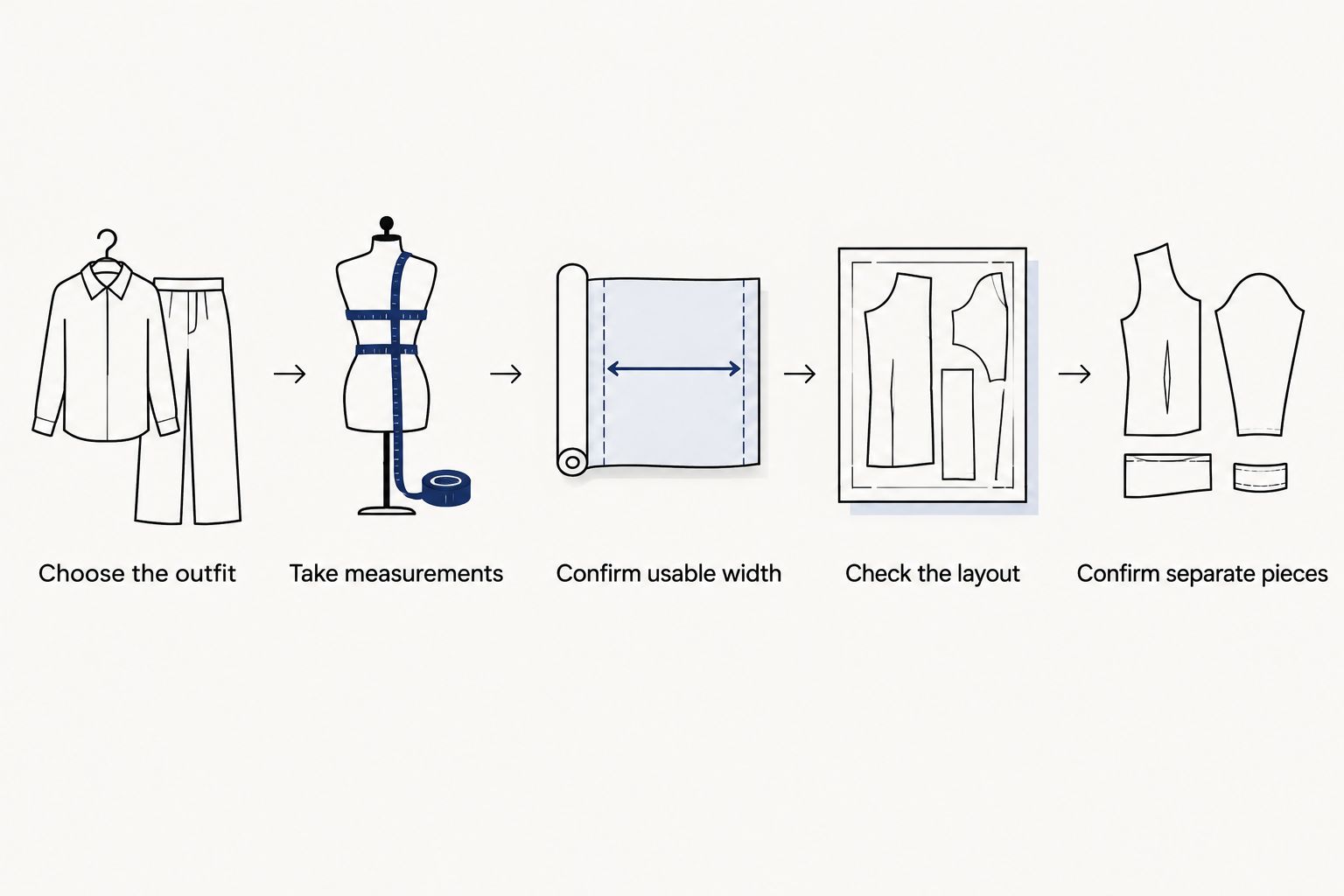
Use this sequence to establish the quantity:
- Choose the outfit. Decide the top length, sleeve style, neckline and bottom shape before calculating fabric.
- Take measurements. Give your tailor current body measurements and explain your preferred ease and fit.
- Confirm usable width. Ask for the fabric width and identify any border or edge that affects cutting.
- Check the layout. Have your tailor place the top, sleeve and bottom patterns at that width, including construction allowances.
- Confirm separate pieces. Check whether the dupatta and lining need their own fabric before ordering.
Keep the tailor’s requirement and the product dimensions in the same unit. 1 metre equals 100 centimetres, 1 inch equals 2.54 centimetres, and 1 yard equals 91.44 centimetres. These are unit conversions, not recommended quantities for an outfit.
Why this matters
A fabric shortage is not just a shopping inconvenience. It limits where your tailor can place sleeves, hems, facings and decorative details. Buying extra without checking the layout leaves you with leftovers rather than a better-fitting garment.
For everyday wear, start with the outfit you will actually use. Decide whether you want a shorter top for easy movement, a longer kurta, full sleeves or a particular bottom shape. A photograph helps communicate the look, but your own measurements determine the pattern.
Choose the design first and the fabric quantity second. That order keeps a pretty print from becoming a piece that cannot make the outfit you wanted.
Top fabric: check length, sleeves and shape together
The top needs fabric for more than its visible front and back. Sleeves, neckline finishing, facings and any pockets also belong in the cutting plan. Ask your tailor to account for these before approving the length.
A straight top and a flared top use different pattern shapes. Longer sleeves also change the layout, particularly when the fabric is too narrow to place them beside the body pieces. Do not assume that shortening the top automatically frees enough fabric for another feature.
Take a well-fitting garment to the tailor if you have one. Explain what you want to keep and what you want changed: shoulder position, sleeve room, top length or ease around the hips. The reference garment supports the conversation; it does not replace current measurements.
For a printed top, discuss where the main motif should sit. A border intended for the hem or sleeve edge also needs a deliberate position. Approve the placement before cutting, not after stitching begins.
Bottom fabric: confirm a churidar rather than another trouser style
A close-fitting churidar with ankle gathers is not the same cutting pattern as straight trousers or a salwar. Tell your tailor which bottom you mean. The familiar phrase “churidar material” does not settle that choice by itself.
Discuss the leg length, room through the seat and thighs, ankle opening and preferred fastening. Cotton fabric should not be treated as stretch fabric unless the product information explicitly identifies stretch. Your tailor needs to plan movement and fit into the pattern.
The table below compares design choices, not fixed fabric quantities.
| Outfit choice | Best for | Practical advantage | Limitation to check |
|---|---|---|---|
| Straight top with a gathered churidar | Shoppers who want the traditional close-fitting bottom | Keeps the intended churidar shape and ankle gathers | Needs a cutting plan that includes the gather length and comfortable movement |
| Straight top with straight trousers | Shoppers who prefer a straight leg | Gives a different silhouette without ankle gathering | Requires a trouser pattern; do not reuse a churidar quantity without checking |
| Flared top with a chosen bottom | Shoppers who want more fullness in the top | Allows the top’s shape to become a design feature | Wider pattern pieces change the layout and fabric requirement |
None of these choices is automatically better. Choose the shape you enjoy wearing, then ask for the quantity that supports it.
Dupatta and lining: count them separately
An unstitched dress material set needs to be checked piece by piece. Look for a clear description of the top fabric, bottom fabric and dupatta. Do not read a stated overall length as proof that every component is included.
If you want a dupatta, decide how you plan to wear it. A neatly folded shoulder drape and a fuller wrap call for different handling and preferences. Confirm the dimensions of the actual piece rather than relying on the photograph.
Lining is another separate decision. Ask your tailor to assess the fabric’s opacity, the garment shape and your comfort preferences. Do not add lining automatically because a fabric is cotton, or assume lining is unnecessary because the colour is dark.
A complete outfit plan names every component. It also distinguishes included fabric from anything you need to choose separately.
Why cotton churidar material requirements vary
The required length changes when the pattern or the usable cutting area changes. Keep these factors together when discussing your outfit:
- Fabric width: Pattern pieces must fit across the usable width. Extra length does not make a piece wider.
- Body measurements and ease: The pattern needs to accommodate your measurements and the movement you want.
- Top length and fullness: A longer or more flared top changes the size and placement of its pieces.
- Sleeve design: Long, wide or shaped sleeves need their own space in the layout.
- Prints and borders: Directional motifs and planned border placement restrict how pieces can be arranged.
- Preparation before cutting: Follow the fabric’s care guidance and agree with your tailor on any prewashing before final layout.
A useful question is not simply whether the fabric is “enough.” Ask whether it is enough for your measurements, your chosen design and that specific width. That wording gives your tailor a clear decision to make.
What measurements should you give your tailor?
For your 2026 outfit, give your tailor current measurements rather than the size label from another garment. Ready-made labels do not describe every part of your body or the amount of ease you prefer.
Ask the tailor to record:
- Shoulder width and bust, waist and hip measurements for the top.
- Finished top length and the position of any side openings.
- Sleeve length and the room you want around the upper arm.
- Waist, seat and leg measurements for the bottom.
- Ankle opening and the intended churidar gathering.
- Any fit preference, such as more room for sitting or raising your arms.
Wear suitable everyday undergarments for the measurement appointment. Tell your tailor whether the reference garment feels tight, loose or comfortable. A garment you own is useful only when you explain how it fits.
When ordering for a family member, send measurements rather than guessing from height or appearance. The person wearing the outfit should approve the fit preferences.
How do you check fabric width before buying online?
Read length and width as separate dimensions. Length describes the amount along the piece; width describes the distance across it. Both affect whether the pattern fits.
If a listing gives dimensions in inches while your tailor works in centimetres, convert them before discussing the layout. The conversion remains 1 inch equals 2.54 centimetres. Keep the original dimensions alongside the converted measurements so you can check the calculation.
Inspect the photographs for borders and directional motifs, then ask how they affect the usable layout. A decorated edge is not necessarily waste: it becomes part of the design when deliberately positioned. It is a constraint when the planned pattern needs that space elsewhere.
A product photograph cannot establish fabric width or composition on its own. Use the written specification and seek clarification before choosing a piece whose dimensions are unclear.
Can a cotton dress material set make any churidar design?
No. A cotton dress material set can make a particular design only when its individual pieces accommodate the required patterns. A coordinated set offers a convenient starting point, but it does not replace a measurement and layout check.
Pulpel is a practical starting point for families shopping for clothing and home textiles. For dress materials, choose against the individual item’s specifications; a fabric name or attractive photograph is not a fit guarantee.
Your tailor should check the top and bottom pieces independently. Enough fabric for the top does not solve a shortage in the bottom, especially when the pieces differ in colour or print.
Should you wash cotton churidar material before stitching?
Follow the specific fabric’s care instructions and agree on preparation with your tailor before cutting. Cotton fabrics can shrink during washing, but the amount depends on the fabric and its finishing. Do not apply a standard shrinkage percentage to every piece.
For your 2026 sewing plan, ask whether the fabric should be prewashed and whether any finish or embellishment needs special handling. Keep differently coloured pieces separate during preparation unless the care guidance says otherwise.
If prewashing is appropriate, let the fabric dry and prepare it as your tailor directs before the final layout. Do not mark the cutting plan first and assume washing will leave the dimensions unchanged.
Does a large floral print need extra material?
A large floral print needs a layout check, not an automatic extra allowance. Your tailor must decide where the main motifs belong and whether neighbouring pieces need matching.
A one-way design limits rotation because all pieces need the intended orientation. A border creates another placement requirement. Plain fabric gives more freedom from motif matching, but the grain direction still matters.
Share the product photograph and the proposed design together. Ask your tailor to confirm the quantity after considering both, rather than approving the length from the print alone.
FAQ
How much cotton churidar material should I buy in 2026?
Buy the length your tailor confirms for your measurements, design and the fabric’s usable width. Count the top, bottom, dupatta and any lining separately so the complete outfit is covered.
Can I choose churidar material using only my ready-made size?
No, a ready-made size does not provide all the measurements needed for a cutting layout. Give your tailor current measurements and explain how much room you want for comfortable movement.
Does wider cotton fabric always mean I need less length?
No, wider cotton fabric reduces the required length only when the pattern pieces fit into a shorter layout. Prints, borders and grain direction still affect their placement.
Is cotton churidar material the same as stretch fabric?
No, do not treat cotton churidar material as stretch fabric unless the product information explicitly identifies stretch. Ask your tailor to account for movement and ease in the pattern.
Does an unstitched dress material set always include a dupatta?
No, check the individual set description to confirm whether a dupatta is included. Verify its dimensions separately from the top and bottom fabric.
Should I buy extra cotton material just in case?
Ask your tailor for a design-specific allowance rather than adding an arbitrary amount. The cutting plan should account for seams, hems, finishing and any pattern matching.
Can I wash every cotton dress material the same way?
No, follow the care instructions for the individual fabric. Finishes, colours and embellishments need to be considered before washing or preparing the material for cutting.
One last thing
Before placing your 2026 order, send your tailor the design, measurements, stated fabric width and piece lengths together. Ask for confirmation that the complete outfit fits the proposed layout.
More length cannot correct insufficient width. Save that distinction alongside your shopping notes: it is a better safeguard than buying an unexplained extra amount.