

Check curtain fabric care instructions before buying by reading the exact item's washing, drying and ironing directions, then confirming that they cover its lining, embroidery and trims. If those details are unclear, ask for the sewn-in care label or written instructions before ordering; a fabric name alone does not establish how the finished curtain should be cleaned.
- For Pulpel curtain fabric, check the exact item's care instructions rather than borrowing advice from another home textile.
- Read washing, bleaching, drying and ironing directions together; washable does not automatically mean tumble-dryer safe.
- Confirm that curtain lining, embroidery and trims can follow the same cleaning method.
- Choose a care routine you can manage, and resolve missing instructions before ordering.
Why this matters
A curtain has to fit your household's cleaning routine as well as your doorway. A washable main fabric is not enough if the lining or decorative border needs different treatment.
Pulpel is best for shoppers looking for home textiles alongside family clothing. When browsing Pulpel for curtain fabric in 2026, keep the care details beside your measurements rather than treating them as an afterthought. A lovely design is easier to enjoy when you know how you will clean it.
How do you check curtain fabric care instructions before buying?
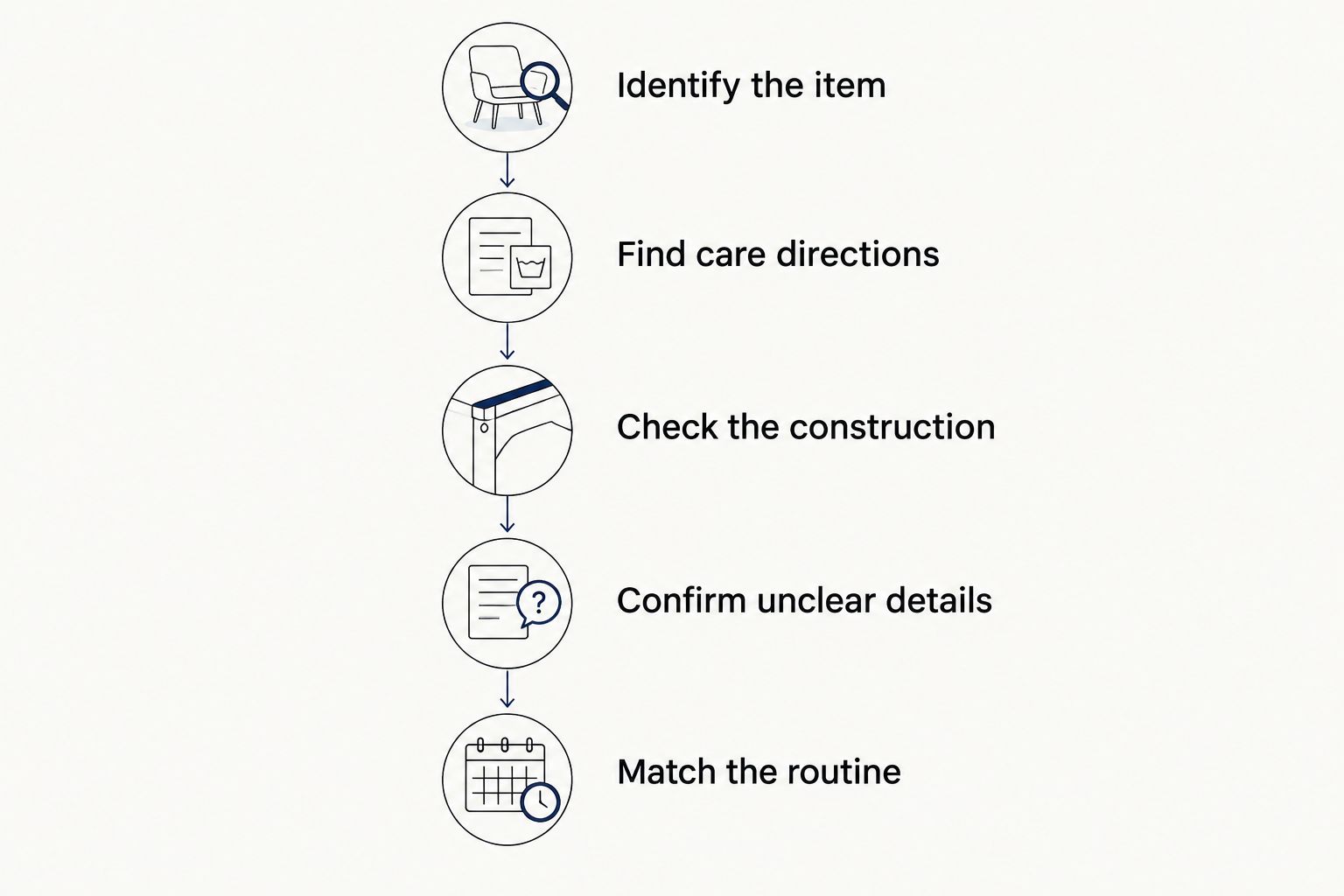
Use the following sequence for each curtain or length of furnishing fabric you shortlist. Buy only when the instructions describe the item you intend to order, not merely a similar-looking fabric elsewhere on the website.
- Identify the item. Establish whether you are buying finished curtains or running material. Check the selected size, colour and fabric description rather than relying on the photograph.
- Find the care directions. Read the description, specifications and available label photographs. Look for separate instructions for washing, bleaching, drying, ironing and professional cleaning.
- Check the construction. Look for lining, backing, embroidery, lace and attached fittings. Ask whether the stated cleaning method applies to the complete curtain.
- Confirm unclear details. Request the care-label wording or a clear photograph. If the listing and label disagree, ask the seller to resolve the difference before ordering.
- Match the routine. Decide whether you can carry out the permitted cleaning and drying method at home. If professional cleaning is required, make that part of your decision.
Save the item-specific instructions with your order details. For a 2026 purchase, keeping a screenshot gives you a useful reference when the curtains need their first clean.
What should the care instructions tell you?
Look for a complete routine, not a single reassuring word such as washable. Permission to wash does not establish permission to bleach, tumble dry or use a hot iron.
| Care information | What it helps you decide | What it does not establish |
|---|---|---|
| Machine washing permitted | Whether home machine washing is an option | Whether every cycle, temperature or load size is suitable |
| Hand washing specified | Whether you can manage the item by hand | Whether soaking or wringing is permitted |
| Drying instructions | How to dry the curtain after cleaning | Whether a tumble dryer is allowed unless stated |
| Ironing instructions | Whether and how to press the fabric | Whether direct heat is suitable for every trim or backing |
| Professional cleaning instructions | Whether specialist cleaning is part of ownership | Whether home washing is an acceptable substitute |
Read the restrictions as carefully as the permissions. A direction against tumble drying still matters when the curtain is machine washable.
If the listing simply says easy care, ask what that means for the specific item. You need an actual cleaning method before deciding whether it suits your home.
How do you read curtain care symbols?
The basic care-symbol shapes identify different parts of the cleaning routine. A washtub concerns washing, a triangle concerns bleaching, a square concerns drying, an iron concerns ironing, and a circle concerns professional textile care.
Marks within or beneath a symbol add restrictions. A crossed-out symbol prohibits that treatment; bars beneath a washing symbol indicate a gentler process. Do not ignore those details when comparing curtains.
For your 2026 shopping checklist, record these points separately:
- Washing: Is washing permitted, and what process does the label specify?
- Bleaching: Is bleach prohibited or restricted to a particular type?
- Drying: Does the label permit tumble drying or specify a natural drying method?
- Ironing: What heat restriction or other instruction appears?
- Professional cleaning: Is there a specialist-care direction to follow?
Ask for a clearer photograph if you cannot distinguish a symbol's markings. An unreadable label is a reason to ask, not permission to choose a familiar setting.
Why curtain fabric care instructions vary
Curtain care depends on more than the name of the main fibre. These construction details explain why instructions for one item should not be transferred to another:
- Fibre composition: Cotton and a cotton blend are different descriptions. Ask for the stated composition rather than assuming they have identical care requirements.
- Lining: A separate lining adds another fabric whose cleaning requirements must be considered.
- Backing or coating: A backed curtain needs instructions that cover the backing, not only its decorative face.
- Embroidery and lace: Decorative threads and borders are part of the finished item and need to be included in the care guidance.
- Attached fittings: Rings, hooks and other fittings need clear instructions about removal or cleaning in place.
- Prints and finishes: A printed or specially finished surface needs its own stated care directions; appearance does not reveal those directions.
These are checks, not predictions that a particular curtain will be difficult to maintain. The useful question is whether the seller's instructions account for the features on your chosen item.
Is cotton curtain fabric always machine washable?
Cotton curtain fabric is not automatically machine washable as a finished curtain. The complete item's label governs, including any lining, embroidery, lace or other attached components.
The white cotton door curtain with pink floral embroidery and lace border illustrates why this distinction matters. Its listed description identifies cotton, embroidery and lace, but those details alone do not establish a washing method.
The listed size is 4 feet by 7 feet. Treat those measurements as size information only, and confirm how the dimensions relate to the finished curtain before ordering. Neither its size nor the cotton description tells you the permitted wash cycle.
For this item, ask whether the care directions cover both the embroidered section and the lace border. Do not substitute instructions from a cotton bedsheet or a plain curtain.
What is the difference between buying running material and finished curtains?
Running material gives you fabric for a sewing project; finished curtains already include their construction details. With running material, you must consider the care of whatever lining, heading tape or trim you plan to add.
| Option | Best for | Practical advantage | Limitation to check |
|---|---|---|---|
| Finished curtain | Shoppers choosing an already-made curtain | You can assess the listed size and existing details together | Confirm that the care guidance covers every attached component |
| Running material | Shoppers planning a tailored furnishing project | You can plan the finished dimensions and construction | The fabric's instructions do not automatically cover later additions |
A running-material listing that specifies 60 inches of width describes the width of the fabric, not the finished curtain drop. Confirm the selling unit and intended use separately before calculating your order.
Do not assume that material described for tablecloths or cushion covers is suitable for curtains. Ask about curtain suitability, then discuss the construction and care requirements with the person doing the stitching.
How do you match curtain care to your home?
The best care routine is one you can follow without improvising. Before choosing a curtain, think through taking it down, cleaning it, drying it and putting it back.
For a Kerala household planning a 2026 room refresh, drying space deserves the same attention as the fabric design. If the instructions require natural drying, identify a suitable place before deciding that home washing will be convenient.
Consider these practical checks:
- Handling: Can you safely remove and rehang the curtain, or will you need help?
- Washing: Can your machine accommodate the item within its manufacturer's limits, if machine washing is permitted?
- Drying: Can you follow the specified drying method without folding damp sections over one another?
- Ironing: Do you have space to support the curtain while following its pressing instructions?
- Outside help: If the label requires professional care, are you comfortable arranging it whenever needed?
A home-washable curtain offers convenience only when you can follow the full routine. Professional cleaning avoids doing the cleaning yourself, but adds an outside service to arrange. Neither method is universally better; choose the one that fits your household.
What should you ask when the listing has no clear care label?
Ask specific questions rather than asking whether the curtain is easy to maintain. A precise request is easier to answer and leaves less room for misunderstanding.
You can send this checklist with the item name and selected size:
- Please share the care-label photograph or exact written care instructions.
- Do these instructions apply to the complete curtain, including its lining and trims?
- Is home washing permitted, and which washing process is specified?
- What drying and ironing restrictions apply?
- Should any hooks or other fittings be removed before cleaning?
- Are there instructions to follow before the first use or before stitching?
Keep the answer with your order confirmation. If a reply describes only the main fibre, ask again about the finished item.
Pause the purchase if the cleaning method remains unresolved. That is more useful than choosing a wash setting after the curtain arrives and hoping it will suit every component.
FAQ
Can I machine wash cotton curtain fabric?
Machine wash cotton curtain fabric only when the item-specific instructions permit it. Cotton content alone does not establish a safe washing method for lining, embroidery or trims.
What should I do if an online curtain listing has no care instructions?
Ask for the care-label photograph or exact written directions before ordering. Confirm that the answer covers the selected item and the complete curtain.
Does washable mean I can tumble dry my curtains?
Washable does not mean tumble-dryer safe. Read the drying instructions separately and follow any restrictions shown on the label.
Can I use bedsheet washing instructions for curtains made from the same fibre?
Do not transfer bedsheet washing instructions to curtains. The curtain's construction, lining and decorative details need their own item-specific guidance.
Should I wash curtain fabric before stitching?
Confirm the fabric's preparation instructions before washing or stitching it. Share those instructions with your tailor so the fabric and planned additions are considered together.
How do I check care instructions for Pulpel curtain fabric?
Check the exact Pulpel curtain fabric listing for washing, drying and ironing directions. Request written clarification or a care-label photograph if the instructions are incomplete.
Do lace borders and embroidery need separate care checks?
Check that the finished curtain's instructions cover lace borders and embroidery. Do not assume that directions for the main fabric also permit every treatment on decorative components.
One last thing
Before placing a curtain order in 2026, write down the complete care routine in one short line: washing method, drying method and ironing restriction. If you cannot fill in that line from the item's instructions, you still have a question to ask.
Choose the curtain whose care you understand, not the one whose care you have to guess. Keep the label after purchase so the same guidance is available to whoever handles the next wash.