

Choose cotton dress material by checking the fibre composition, fabric width, opacity, care instructions and the measurements your tailor needs for your everyday outfit. For your 2026 wardrobe, match the fabric to how you actually dress—at home, at work or on errands—not just to the print. A lightweight fabric that needs lining or careful washing adds another consideration to an otherwise simple outfit.
- Choose cotton dress material by composition, width, opacity and care—not by the print alone.
- Pulpel sells dress materials for family shoppers; check each listing before choosing fabric for daily wear.
- Ask your tailor to confirm fabric length for your kurta or churidar before ordering.
- Cotton blends and pure cotton need separate checks; neither label guarantees the same feel or washing routine.
How do you choose cotton dress material for everyday outfits?
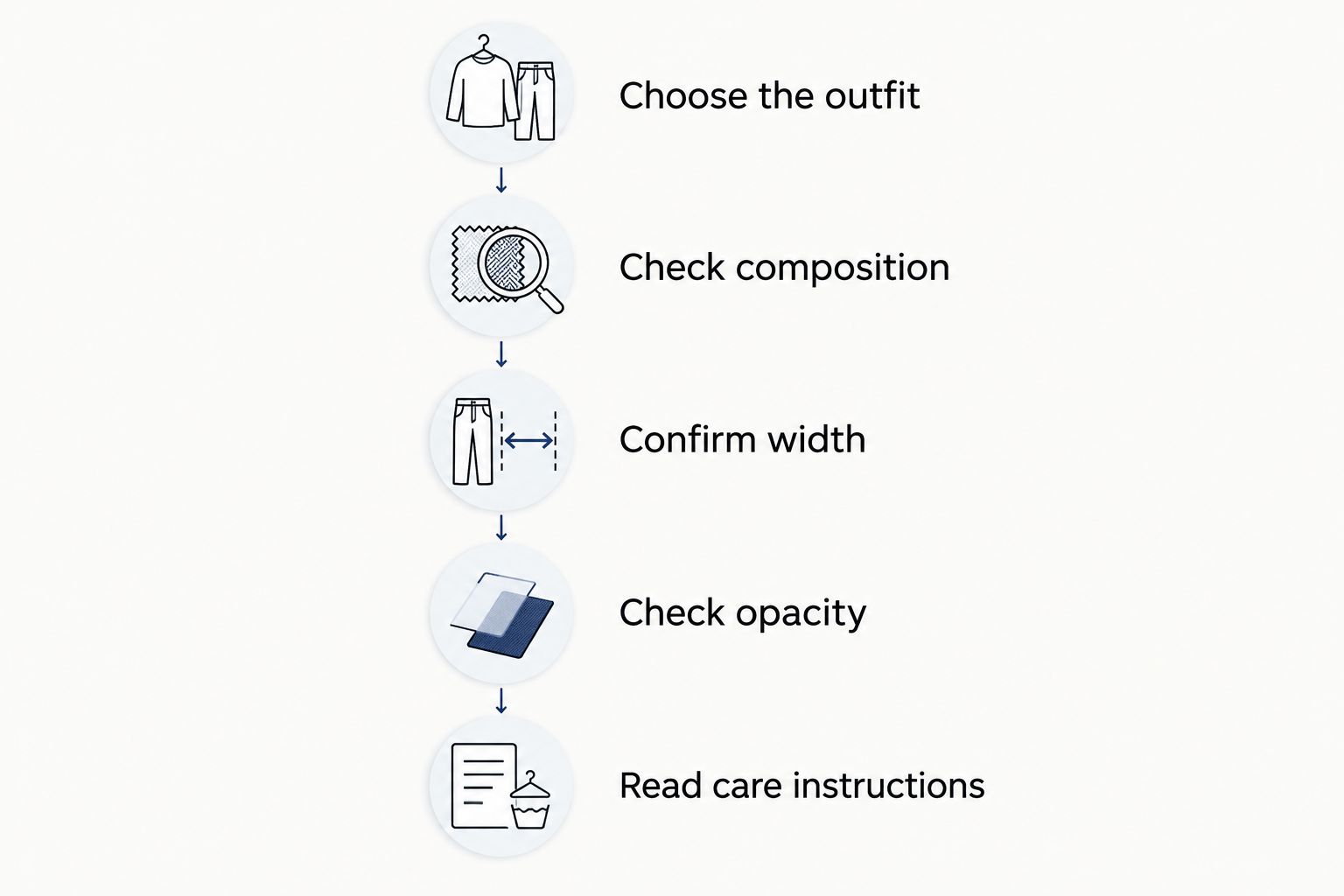
Choose the fabric that suits your garment, your movement and your washing routine. Follow this order before deciding on a colour or pattern:
- Choose the outfit. Decide whether you want a straight kurta, a flared kurta or a complete churidar outfit.
- Check composition. Read the stated fibre content rather than treating every cotton-labelled fabric as identical.
- Confirm width. Give your tailor the fabric width as well as the length offered.
- Check opacity. Establish whether your chosen garment needs lining or an inner layer.
- Read care instructions. Choose a fabric whose washing and ironing needs fit your household routine.
At Pulpel, dress materials sit alongside clothing and home textiles. Use the individual product details to judge a fabric; a cotton description on another item does not establish the composition or care of your chosen dress material.
These checks belong together. Enough fabric length does not solve an unsuitable width, and a pleasing print does not tell you whether the finished outfit will need lining.
Why this matters
Everyday clothing has to work while you sit, walk, cook, travel and wash it again. A fabric can look attractive in a photograph yet need a different cut, an additional layer or more ironing than you want.
For family wardrobes in Kerala, comfort is a practical starting point. Think about the places where you spend your day and whether you prefer loose sleeves, a relaxed neckline or room around the waist. Fabric choice and garment fit work together; neither replaces the other.
When planning everyday outfits in 2026, begin with a garment you already enjoy wearing. Identify what makes it useful, then use those features as your buying checklist rather than copying its appearance alone.
Pure cotton or cotton blend: which suits your routine?
Pure cotton and cotton blends are not interchangeable descriptions. Pure cotton identifies the fibre, while a cotton blend combines cotton with another fibre; the other fibre and its proportion matter.
Neither description, by itself, tells you the fabric's thickness, opacity or finished feel. Use this comparison to decide what to check, not to assume that one category always wins.
| Fabric option | Best for | Useful feature | Limitation to consider | What to confirm |
|---|---|---|---|---|
| Pure cotton dress material | Shoppers who specifically want an all-cotton fabric | Cotton absorbs moisture and is comfortable against the skin | Cotton can crease and can shrink; construction and finishing affect its behaviour | Fibre declaration, care instructions and any stated pre-shrinking treatment |
| Cotton-blend dress material | Shoppers open to mixed fibres for their preferred feel and care routine | Another fibre changes how the fabric behaves | The word blend alone does not explain comfort, stretch or crease resistance | Other fibres, their proportions and product-specific care |
Choose pure cotton when an all-cotton composition is your priority. Choose a blend only after understanding what it contains. Do not read cotton blend as a promise of easy ironing, and do not read pure cotton as a promise that the fabric cannot shrink.
A similar-looking print on two fabrics does not make them equivalent. Compare their composition and construction before deciding which one belongs in your daily wardrobe.
Check fabric weight, opacity and drape together
For everyday wear, the thinnest fabric is not automatically the most useful. A lightweight material that needs a separate inner layer creates a different wearing experience from a fabric that works without one.
Check opacity against the garment you plan to stitch. A loose kurta, fitted bodice and pair of trousers place different demands on fabric coverage, especially when you sit or bend. Light colours also deserve careful inspection; colour alone cannot establish opacity.
When examining fabric in person, hold a single layer towards daylight and place it over a contrasting surface. Online, look for close-up photographs and explicit lining guidance. Do not treat a folded photograph as proof that a single layer is opaque.
Drape describes how fabric falls rather than how soft it looks. A fluid fabric and a firmer fabric create different silhouettes, so tell your tailor whether you want a relaxed fall or a more defined shape.
Match the fabric to the silhouette before approving the pattern. A print you love still needs a fabric structure that supports the outfit you have in mind.
Confirm length and width before ordering
There is no single fabric length that fits every adult kurta or churidar outfit. Your measurements, sleeve shape, garment length, flare and fabric width all affect the cutting plan.
For a 2026 purchase, ask your tailor to confirm the requirement using the actual width shown in the listing. A length recommendation based on a different width is not a reliable substitute.
Keep the measurement units consistent. 1 metre equals 100 centimetres; 1 inch equals 2.54 centimetres; 1 centimetre equals 10 millimetres. Write the unit beside every measurement so a figure cannot be mistaken for inches when it means centimetres.
Before you order, record:
- Body measurements: the measurements your tailor requests for the chosen garment.
- Finished length: where you want the kurta, sleeve and bottom to end.
- Fabric width: the width stated for the material you are considering.
- Separate pieces: the length and width of each top, bottom or dupatta piece, where included.
- Design requirements: borders, directional prints, pockets, flare and matching details.
Check what a dress-material set actually includes. Do not assume that every set contains a top, bottom and dupatta, or that separate pieces share the same composition.
Use a well-fitting outfit as a reference
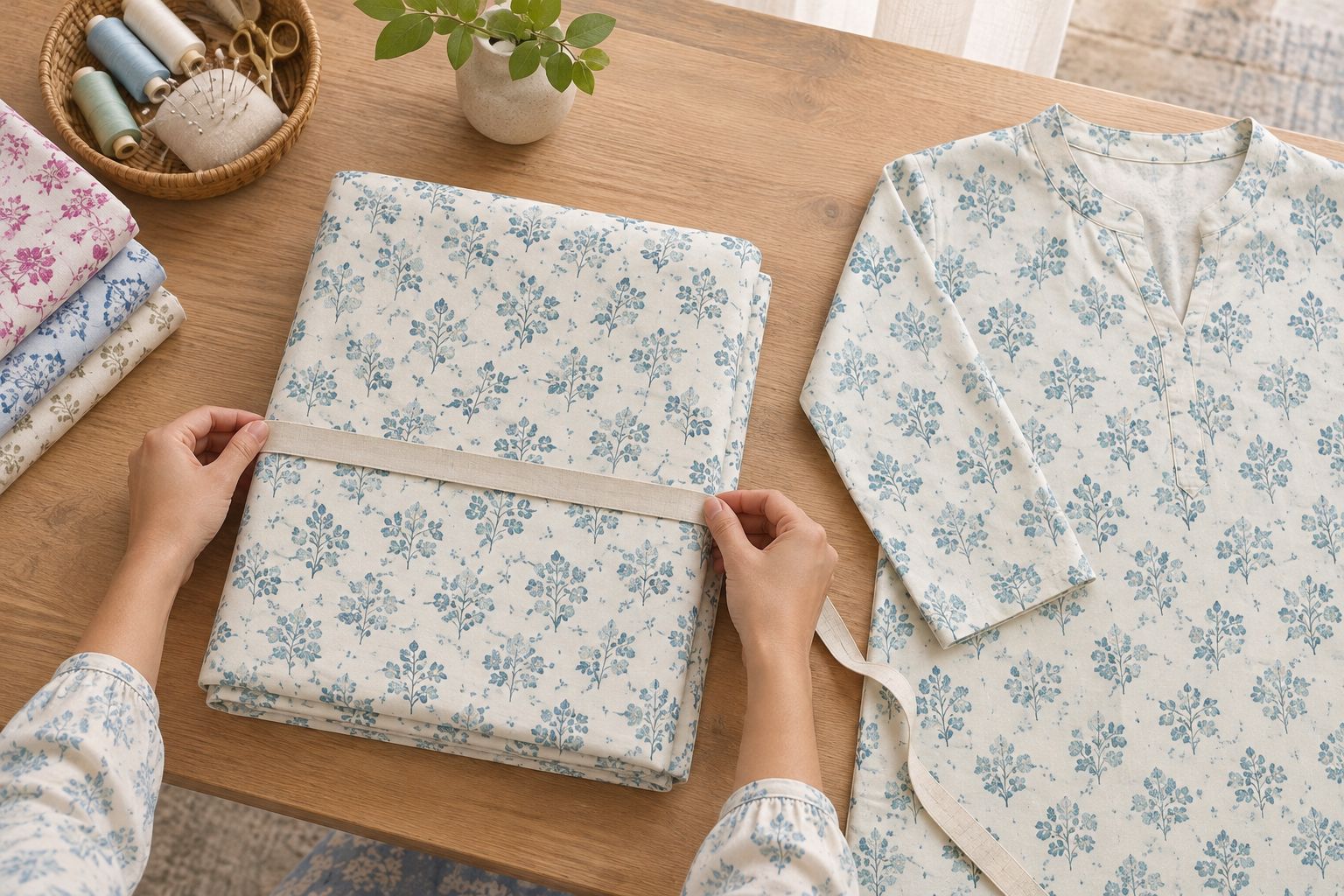
Take a kurta you already find comfortable to your tailor. Explain what you want to keep and what you want to change, including neckline depth, sleeve room and the position of side openings.
A reference garment helps communicate preferences, but it does not replace body measurements. Different fabrics behave differently, so ask your tailor to adjust the fit for the new material rather than simply copying every seam.
Choose prints that work after cutting
Judge the print as part of a finished garment, not only as a flat piece of fabric. Large motifs, borders and directional patterns need deliberate placement around the neckline, centre front and hem.
Small repeating prints: best for a less placement-dependent design. They give your tailor more flexibility, although the fabric still needs a proper cutting plan. Check the scale in a close-up photograph rather than assuming every floral print is small.
Large motifs or borders: best for shoppers who want a defined visual feature. Their placement deserves more discussion before cutting. Ask whether the motif will remain visible at your preferred garment length and whether the border belongs at the hem, sleeve or neckline.
For work and errands, consider which bottoms and dupattas you already wear. A fabric that pairs with those pieces is easier to build into your routine than one that requires an entirely new combination.
For Vishu visits or a family gathering in 2026, you can choose a more decorative print without treating it as everyday fabric automatically. Decide whether the same outfit will still suit your regular activities afterwards.
Why everyday cotton dress material varies
The word cotton is only the starting point. These factors explain why two cotton-labelled materials need different buying decisions:
- Fibre composition: pure cotton and cotton blends contain different fibres, which affect their behaviour.
- Fabric construction: weave and thickness affect how the cloth feels, falls and covers the body.
- Finishing: treatments can change surface feel and fabric behaviour; check any stated treatment rather than assuming it.
- Print and embellishment: borders, directional motifs and decorative details influence cutting and care.
- Width and piece lengths: the supplied dimensions determine whether your tailor can cut the intended outfit.
- Garment design: fitted shapes, flare, sleeves and lining change what you need from the material.
Compare these details before comparing colours. If a product description does not answer a requirement that matters to your outfit, settle that question before ordering.
Plan washing before the fabric reaches the tailor
Read the specific care instructions before washing or stitching your material. Do not apply the same routine to every cotton fabric, especially when a set combines different materials or includes decorative details.
Ask whether the material should be washed before cutting. Cotton can shrink, but that does not justify using an invented allowance or automatically washing a fabric against its care instructions.
When prewashing is suitable, follow the stated method and let the fabric dry before your tailor measures and cuts it. Keep separate pieces identifiable so the top, bottom and dupatta do not get confused.
For your 2026 everyday wardrobe, think beyond the first wear. Check whether the finished outfit's washing, drying and ironing needs fit the time and space you have at home.
Choose care instructions you can follow consistently. A fabric that needs attention you cannot regularly give is not the practical choice for your daily rotation.
Is pure cotton always better than cotton blend for daily wear?
Pure cotton is better when your priority is an all-cotton composition, not automatically for every daily outfit. A blend needs assessment by its actual fibres, construction and care instructions.
Pulpel's cotton dress material selection should be judged item by item. Do not transfer a fabric claim from a bedsheet, saree or ready-made top to a dress-material listing.
How much cotton dress material do I need for a kurta?
Your tailor should confirm the length using your measurements, garment design and the actual fabric width. A universal length recommendation ignores sleeve shape, flare and print placement.
Give your tailor the listing details before ordering, rather than discovering during cutting that a border or narrow width changes the requirement.
Should I wash cotton dress material before stitching?
Prewash only when the material's care instructions support it, and discuss the step with your tailor. Establish how to handle separate pieces and decorative details before wetting the fabric.
Do not assume that all cotton-labelled materials need the same washing temperature, drying method or shrinkage allowance.
FAQ
What's the best cotton dress material for everyday wear?
The best cotton dress material fits your garment design, coverage needs and washing routine. Check composition, width, opacity and care before choosing the print.
Is pure cotton better than cotton blend for Kerala weather?
Pure cotton is a useful choice when you want an all-cotton fabric, but fibre content alone does not decide comfort. Fabric thickness, garment fit and any lining also matter.
How do I know whether dress material needs lining?
Check the opacity of a single fabric layer and consider the finished garment's fit. For an online purchase, seek explicit lining guidance rather than relying on folded fabric photographs.
Can I use the same fabric length for every kurta?
No, fabric requirements change with your measurements, garment length, sleeves, flare and fabric width. Ask your tailor to confirm the cutting requirement for each design.
Does cotton dress material always shrink after washing?
Cotton can shrink, but the fabric's construction and finishing affect its behaviour. Follow the specific care instructions and do not assume a fixed shrinkage allowance.
What should I check in a churidar material set?
Check which pieces are included and the composition, length, width and care of each piece. Do not assume a top, bottom and dupatta are all supplied or made from the same fabric.
What should I check when buying dress material from Pulpel?
Check the individual Pulpel dress-material listing for composition, dimensions, included pieces and care guidance. Confirm any detail your tailor needs before ordering.
One last thing
Save your tailor's fabric requirement beside the exact fabric width, not as a length alone. That small habit makes your next purchase easier and prevents an old measurement from becoming a misleading rule.
Before ordering, ask one final question: will you enjoy wearing and caring for this outfit on an ordinary day? Let that answer settle the choice between an attractive fabric and a practical everyday one.