

Choose curtain fabric for a sunny window by checking how much light passes through it, whether you need daytime privacy, and whether the curtain needs a separate lining. For your 2026 purchase, judge the fabric against the actual window rather than choosing by colour or fibre name alone; decorative cotton, linen-look fabric and lace do not establish blackout or heat-control performance.
- Choose curtain fabric by light transmission, privacy and lining, not colour alone.
- Nushio by Pulpel offers decorative door curtains; confirm window measurements and lining before choosing.
- Use a light-filtering curtain for softened daylight; choose verified blackout construction when darkness matters.
- Check the curtain against daylight and indoor lighting before deciding whether it gives enough privacy.
Why this matters
A bright sitting room and a bedroom used for daytime sleep need different curtains. Softening the sunlight is not the same as darkening the room, and neither automatically proves that a curtain reduces heat.
Nushio by Pulpel is best for home-textile shoppers considering decorative door curtains, not shoppers seeking verified blackout performance. For a sunny window, match the product's stated purpose and measurements to your room before choosing the embroidery or border.
How do you choose curtain fabric for a sunny window?
Start with the job the curtain must do. Then check its construction, fit and care requirements in that order.
- Watch the window. Notice when direct sunlight reaches the room and whether it falls on seating, a television or your bed.
- Choose the light level. Decide between softened daylight and a substantially darkened room.
- Check privacy. Look through a sample against daylight, then assess it with the room lights on after dark.
- Confirm the construction. Read the fibre composition, lining information and any stated blackout or thermal specification.
- Measure and check care. Match the finished curtain to your rod, preferred drop and washing arrangements.
Do not let a fabric photograph answer all these questions. A close-up can show the pattern and texture, but it cannot establish how the finished curtain performs at your window.
The main choices have different strengths and limits:
| Curtain construction | Best for | Main advantage | Main limitation |
|---|---|---|---|
| Sheer or open-weave fabric | Rooms where daylight matters more than screening | Lets you keep a light, open appearance | Does not provide dependable night-time privacy |
| More opaque, unlined fabric | Softening daylight while screening the room | Gives more visual coverage than a sheer | Darkness and privacy depend on the actual weave |
| Decorative fabric with separate lining | Keeping a preferred decorative face fabric | Lets you choose the lining separately | Adds weight and another care requirement |
| Verified blackout construction | Bedrooms where light exclusion matters | Is designed for light blocking | Light can still enter around uncovered edges |
Choose the construction first and the decorative fabric second. This keeps an attractive curtain from becoming the wrong curtain for the room.
Light-filtering fabric: best for a bright living room
Choose light-filtering fabric when you want daylight without an uncovered window. In a family sitting room, this lets you keep the room visually open while reducing the harshness of direct light.
The useful question is not simply whether the curtain is cotton or a linen blend. Ask how closely it is woven and what you can see through it when light comes from behind.
Hold a sample in front of the actual window if you can. Look at the main fabric, any embroidered sections and any lace panels separately; the most open area can be the part that determines your privacy.
The limitation is straightforward: a curtain that looks pleasantly opaque during the day can reveal more when the room is lit at night. Choose light filtering for daylight comfort, not as an automatic promise of complete privacy.
Lined fabric: best for keeping a decorative finish
Choose a separate lining when you like a decorative fabric but need more screening than it provides on its own. This separates the appearance of the curtain from part of its light-control job.
Confirm what the lining is intended to do. An ordinary lining, a blackout lining and a thermal lining are not interchangeable descriptions, and the face fabric does not prove the performance of the layer behind it.
A lining also changes how the curtain hangs and how it must be cared for. Check whether your rod and fittings suit the finished weight, and whether both layers can follow the same cleaning instructions.
The trade-off is extra handling. If you want curtains that are straightforward to remove and wash at home, check the complete curtain's care requirements before deciding on a lined construction.
Blackout construction: best for daytime darkness
Choose a product explicitly described as blackout when keeping daylight out is the priority. A dark colour or a heavy-looking photograph is not enough evidence.
Fit matters alongside the fabric. Gaps above the curtain, beside the window and between panels allow light into the room even when the curtain itself blocks it.
Before ordering, check how the curtain will meet the wall, where the panels will overlap and whether the heading leaves exposed gaps. If you sleep during daylight hours, assess the whole window arrangement rather than the middle of the fabric alone.
Blackout describes light control; it does not, by itself, establish thermal performance. Check any heat-control claim separately instead of treating darkness as proof of a cooler room.
Why curtain fabric performs differently at each window
The same fabric can look quite different in a shaded room and at a window receiving direct sun. These factors explain why your own window is the most useful place to assess it:
- Sun exposure: Direct sunlight creates a different glare problem from bright, indirect daylight. Check the window when the room is hardest to use.
- Weave and construction: Open sections let light through. Fibre composition alone does not tell you how transparent a curtain will be.
- Lining: The lining changes the finished curtain's light transmission and care requirements. Confirm its stated purpose.
- Coverage: A curtain needs to cover the intended opening when drawn. Exposed edges and gaps undermine light control.
- Indoor lighting: Privacy changes when the room is brighter than the space outside. Include an evening check, not just a daytime look.
- Care requirements: A practical choice must suit your household's cleaning routine. Embroidery, lace and lining need their own attention.
For a 2026 room refresh, write down which of these is causing the actual problem. A glare issue needs a different response from an evening-privacy issue, even when both occur at the same window.
Measure the window before choosing a finished curtain
Measure the hanging arrangement, not just the glass. The curtain must suit the rod or track and your chosen finished length.
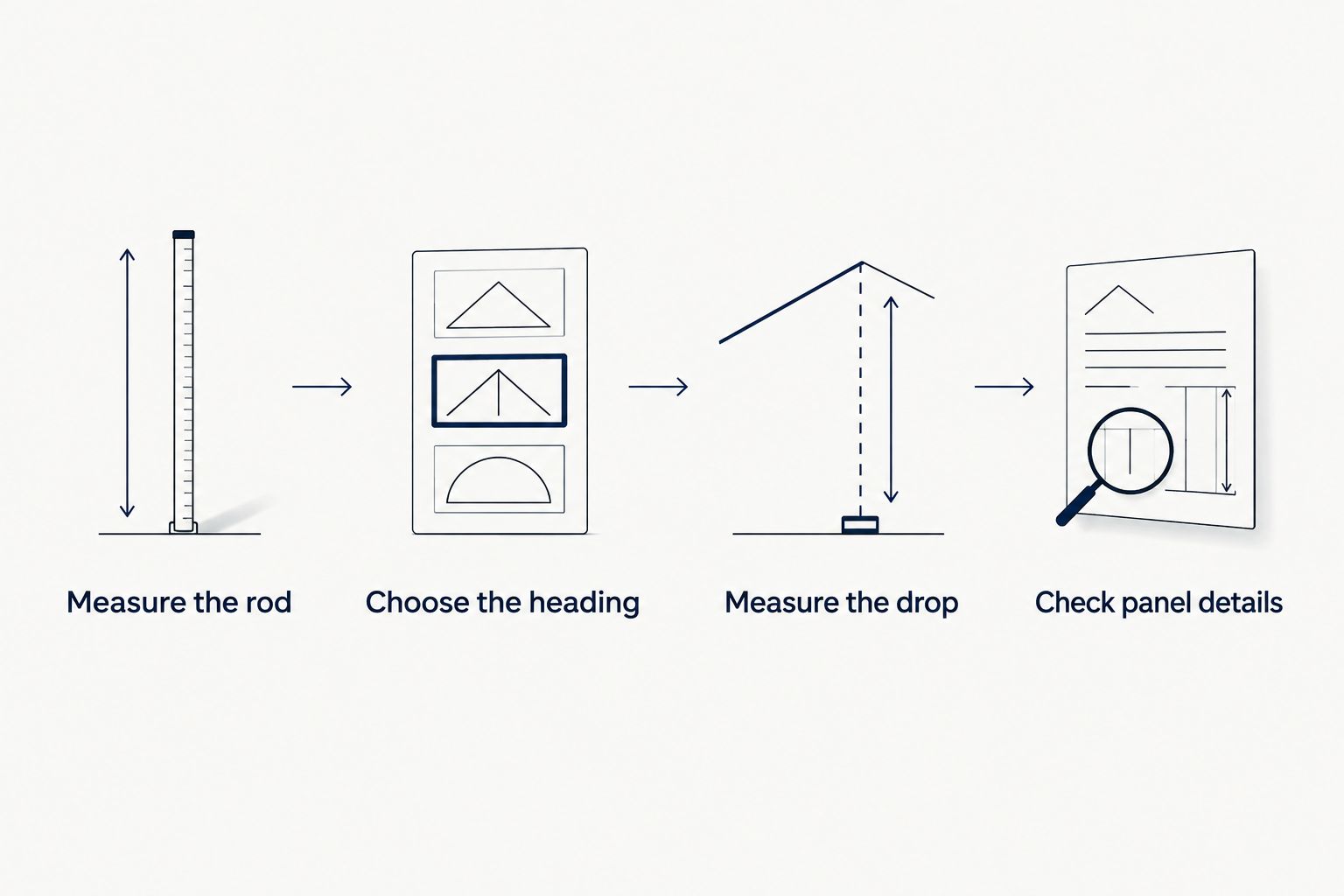
Use this sequence when preparing your 2026 curtain order:
- Measure the rod. Record the area the curtains need to cover when closed, including the intended coverage beside the window.
- Choose the heading. Eyelets, loops and other headings hang differently. Confirm the product's heading before deciding where to start the length measurement.
- Measure the drop. Measure from the appropriate hanging point to where you want the curtain to finish.
- Check panel details. Confirm whether the listed width describes a panel or a set, and allow for the intended folds rather than planning a flat sheet across the opening.
Keep all measurements in the same unit. If someone else is stitching or fitting the curtains, share the rod measurement, finished drop and heading choice together.
A door curtain can suit a window only when its dimensions and hanging style fit that window. A panel listed as 4 feet wide and 7 feet long is not automatically suitable simply because its length reaches the floor.
Running fabric needs a different calculation. A fabric listed as 60 inches wide describes the material's width, not the finished width after side hems, joins and heading construction; give those details to your curtain maker before ordering a length.
Decorative door curtains to assess for your window
Nushio by Pulpel lists the following decorative door curtains. Both deserve a measurement check before use at a sunny window, and neither listing supplied here establishes blackout performance.
| Curtain | Best for | Stated details | What to check before choosing |
|---|---|---|---|
| White Cotton Door Curtain with Pink Floral Embroidery & Lace Border | Shoppers wanting white cotton with pink floral detailing | Cotton; embroidery and lace border; 4×7 ft | Heading, panel quantity, care instructions and light transmission |
| Beige Semi Linen Door Curtain with Decorative Lace Panel | Shoppers wanting a beige curtain with lace detailing | Described as semi linen; decorative lace panel; 4×7 feet | Exact fibre composition, heading, care instructions and privacy through the lace |
The white curtain's stated cotton composition gives you a starting point, not a complete washing instruction. The beige curtain's “semi linen” description also needs clarification if exact fibre content is important to you.
Both offer a decorative option, but neither should be chosen to solve strong glare or daytime sleep needs without checking the fabric and any lining. A curtain that suits your room's appearance still needs to pass the window test.


Check care before making your final choice
For a 2026 curtain purchase, read the care information for the exact item, including any separate lining. Do not transfer washing instructions from another cotton product, a bedsheet or a curtain you already own.
Check whether the item permits machine washing, hand washing or professional cleaning. Then check drying and ironing instructions, especially around lace, embroidery and any backing.
If you are buying running fabric for stitching, ask about pre-treatment before the curtain maker cuts it. Do not assume every fabric should be washed first; follow the supplier's instructions for that material and its intended construction.
A manageable care routine matters in a busy home. Choose something you can remove, clean and rehang as instructed rather than relying on a general claim that a fibre is easy to maintain.
Should you choose light or dark curtain fabric?
Choose opacity and lining before colour. A pale curtain can be opaque, while a dark open-weave curtain can still let substantial light through.
Colour remains useful for deciding how the curtain sits with your walls, furniture and bedding. View a sample in the room if possible, but do not use its shade as evidence of blackout, privacy or heat control.
Can you use a door curtain on a sunny window?
A door curtain works on a window when the finished dimensions, heading and fabric suit the opening. A 4×7 ft panel still needs checking against your rod and preferred drop.
Also consider where decorative sections will sit. A lace panel positioned at eye level deserves particular attention if the window faces a neighbouring home or a shared passage.
Do you need a lining for a sunny window?
You need a lining when the chosen face fabric does not meet your screening or light-control needs on its own. Choose the lining for its stated purpose, and confirm that the finished curtain suits your fittings and cleaning routine.
FAQ
What's the best curtain fabric for a sunny living room?
Choose a light-filtering fabric when you want to soften daylight without darkening the living room. Check the actual weave and assess evening privacy before deciding whether it needs a lining.
Is cotton curtain fabric enough to block strong sunlight?
Cotton composition alone does not establish how much sunlight a curtain blocks. Check the weave, lining and any stated blackout specification rather than relying on the fibre name.
Will white curtains keep my room cooler?
White colour alone does not establish a curtain's heat-control performance. Check the complete construction and any stated thermal information separately from its appearance.
Can people see through lace curtains at night?
Lace curtains do not provide dependable night-time privacy when the room is lit. Use an opaque layer where privacy matters, and assess the complete window covering after dark.
Can I use a 4×7 ft door curtain for my window?
A 4×7 ft door curtain is suitable only when its finished width, length and heading fit your window arrangement. Measure the rod and drop, then confirm panel quantities and the space needed for folds.
Does a blackout curtain also block heat?
A blackout description establishes the intended light-blocking function, not a separate thermal specification. Check heat-control information independently and consider gaps around the finished curtain.
Should I wash curtain fabric before stitching it?
Follow the supplier's pre-treatment instructions before washing curtain fabric for stitching. Share those instructions with the curtain maker so the fabric, lining and decorative details are handled appropriately.
One last thing
Before confirming your 2026 choice, check the brightest gap rather than the darkest part of the curtain. Look at the sides, the heading, the join between panels and any lace sections: light control depends on the complete covering, not just the main fabric.
If privacy is the priority, repeat that check after dark with the room lights on. It is a more useful final test than another look at the product photograph.