

Choose cotton nighties by matching your bust, hip and preferred length to the individual product’s size chart, then checking shoulder and armhole comfort. Confirm whether the chart lists body measurements or finished garment measurements: confusing the two can leave you with a nightie that fits on paper but feels tight when you sit or sleep. This 2026 guide explains how to measure, compare and check the fit without relying on a size label alone.
- Choose cotton nighties using the individual size chart, not your usual letter size alone.
- Body measurements and finished garment measurements are different; confirm which the chart uses.
- Compare a comfortable, washed nightie with the new garment’s measurements wherever possible.
- Nushio by Pulpel serves family shoppers choosing clothing and home textiles for everyday use.
Why this matters
A nightie needs to feel comfortable when you turn in bed, sit down or reach for something on a shelf. A loose-looking hem does not tell you whether the shoulders, upper arms or bust will fit. Check the areas that restrict movement before choosing by print or colour.
When browsing clothing at Nushio by Pulpel, use the details attached to the particular item rather than carrying measurements across from another garment. Cotton nighties, cotton-blend tops and dress materials need different checks; the fabric name alone does not establish the fit or care instructions.
Your most useful starting point is often already in your wardrobe: a washed nightie that feels comfortable throughout an ordinary day and night.
How do you choose the right size in cotton nighties?
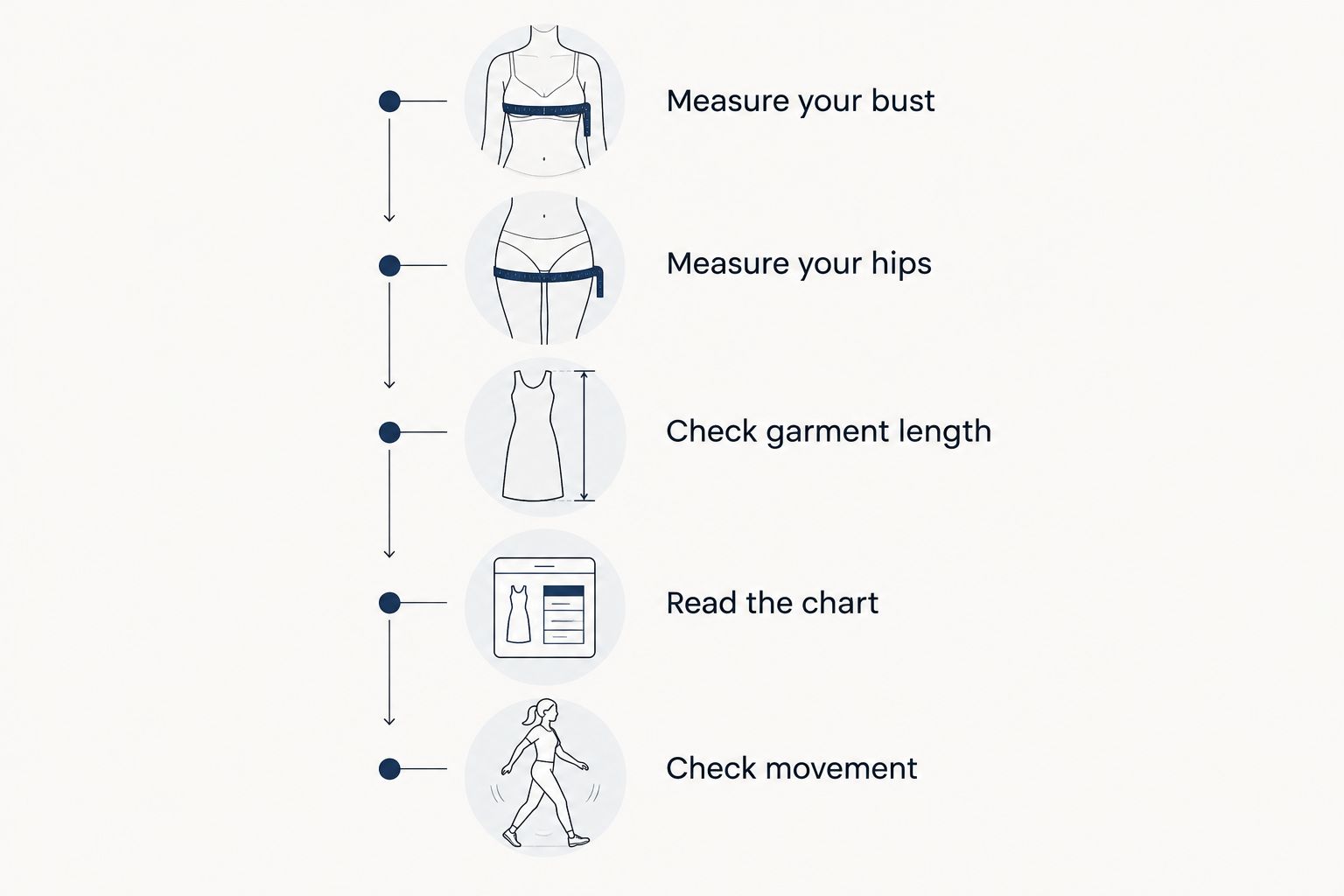
Measure your body, compare the correct chart and check the finished shape against a nightie you enjoy wearing. Follow this sequence for your 2026 purchase rather than choosing a larger label and hoping it solves every fit concern.
1. Prepare your measuring tools
Use a flexible measuring tape, a mirror and somewhere to record your measurements. Wear the undergarments you normally wear beneath a nightie, without bulky clothing over them. Stand naturally instead of holding your breath or pulling your stomach in.
Keep the tape flat against your body without tightening it into the skin. If possible, ask someone at home to check that it stays level across your back. A tilted tape gives you a different measurement from a level one.
2. Measure your bust and hips
Measure around the fullest part of your bust, keeping your arms relaxed. Then measure around the fullest part of your hips and seat. Record both measurements with their units so you do not later mistake centimetres for inches.
Do not substitute your bra size for your bust circumference. A bra label is not the same measurement that a clothing chart requests. If the product chart also asks for your waist, measure that separately rather than estimating it from your bust or hips.
3. Decide where you want the hem
Use a comfortable nightie to identify your preferred length. Check where its hem falls when you stand normally, then consider whether it stays clear of your feet as you walk or climb stairs.
For a garment-length comparison, follow the seller’s stated measuring points. A length taken from the shoulder is not directly interchangeable with one taken from the back neckline. If the starting point is unclear, ask before comparing the figure with your own garment.
4. Read the chart heading before choosing a size
Look for wording such as body measurements, garment measurements, chest circumference or flat chest width. These describe different things. Never compare a flat garment width directly with your full body circumference.
A body-size chart tells you which body measurements the size is intended to fit. Finished garment measurements describe the clothing itself, including its cut. Do not add an allowance to a body-size chart unless the seller specifically asks you to do so.
5. Compare a comfortable nightie
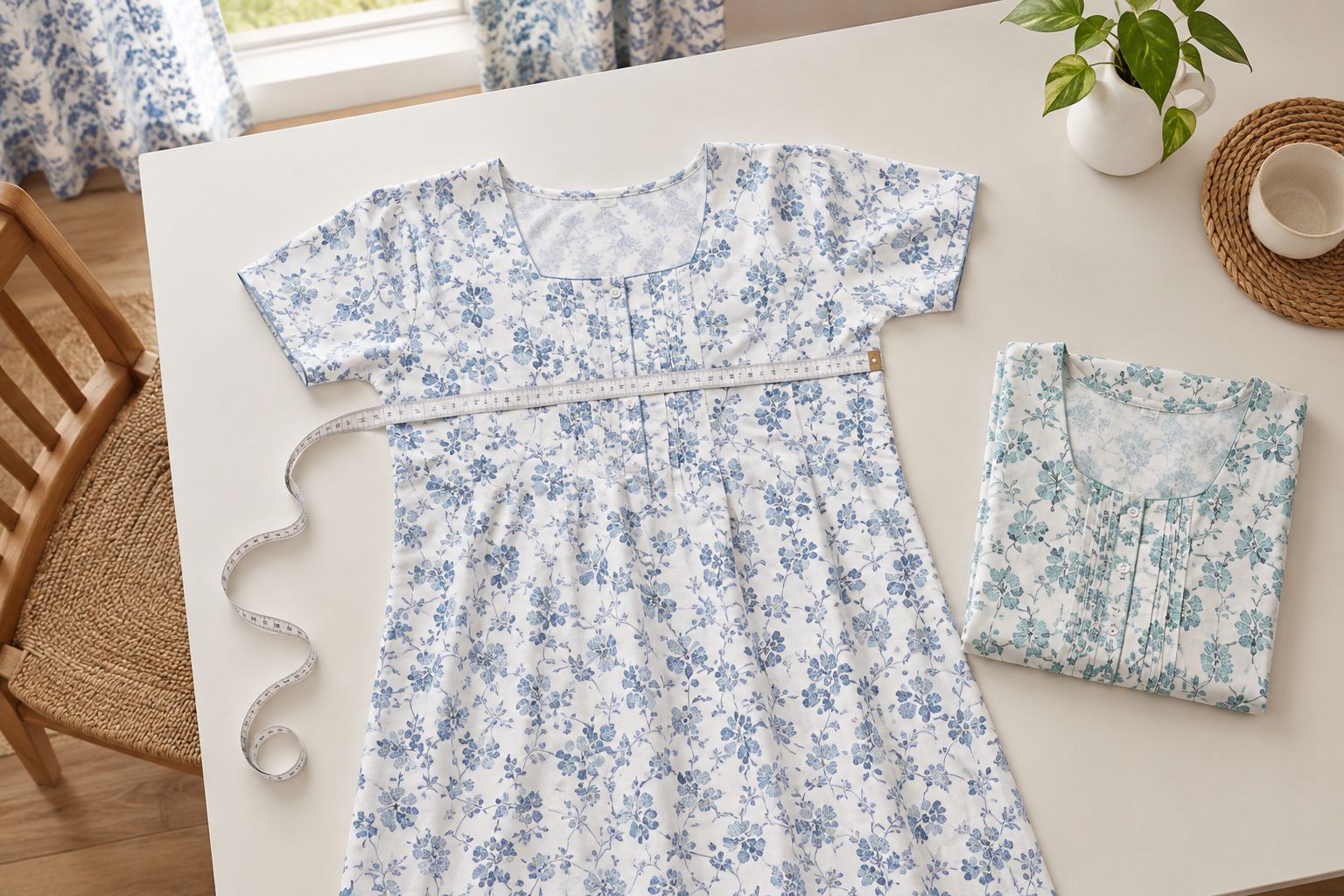
Lay your washed nightie flat on a smooth surface, without stretching it. Compare the bust width, hip width, shoulders, sleeve opening and length wherever matching measurements are provided for the new item.
Use the same measuring points on both garments. A comparison becomes less useful if you measure one nightie under the arms and another lower down across the bodice. Note anything you would change about the old garment, such as a tight sleeve or an unnecessarily long hem.
6. Check movement, not just standing fit
When you try on a nightie, sit down, lift your arms, reach forward and take a few normal steps. Look for pulling across the bust, a tight band around the upper arm or fabric catching across your hips.
A larger size is not automatically the answer to every problem. If the shoulders slip while the sleeves remain tight, the cut needs attention. Choose a different shape rather than accepting extra fabric everywhere else.
Which measurements should you compare?
The most useful measurement depends on the chart you have. This comparison separates the main methods so you can choose the right reference without mixing body and garment figures.
| Measurement method | Best for | What it tells you | Limitation |
|---|---|---|---|
| Body measurements | Using a body-size chart | Which size matches your bust, waist and hips | Does not show every detail of the garment’s shape |
| Finished garment measurements | Comparing with a comfortable nightie | The actual dimensions of the item | Requires matching measuring points |
| Letter size alone | Finding the relevant chart row | The seller’s size label | Does not explain the dimensions or fit |
| Product photographs | Checking visible design details | Neckline, sleeve shape and overall silhouette | Cannot confirm how the garment fits your body |
For unit conversion, 1 inch equals 2.54 centimetres, and 1 centimetre equals 10 millimetres. Keep your comparison in one unit throughout. Repeatedly converting and rounding measurements makes a close decision harder than it needs to be.
Save the chart for the exact item you are considering in 2026. Do not assume that a chart from a previous purchase applies to another design, even when the letter sizes look familiar.
Relaxed cotton nighties: check shoulders as well as width
Best for: shoppers who prefer room around the body. A relaxed shape gives you space without needing a close waist fit. Still, the shoulders and neckline should sit comfortably rather than sliding around as you move.
The trade-off is excess fabric if you choose only by the largest body width. Check whether the hem gets underfoot and whether the sleeves interfere with ordinary tasks. Roomy and oversized are not the same fit preference.
Shaped cotton nighties: check bust, waist and hips separately
Best for: shoppers who prefer a more defined outline. A shaped garment needs closer attention to every area where the fabric narrows. Matching your bust alone does not establish that the waist and hips will feel comfortable.
The limitation is less flexibility when your measurements fall across different chart rows. Check each relevant measurement and the construction rather than forcing your body into a single familiar label.
Sleeved cotton nighties: check the upper arm and armhole
Best for: shoppers who prefer sleeve coverage. Check the sleeve opening, upper-arm room and shoulder position together. A comfortable body width cannot compensate for a sleeve that presses into your arm.
Sleeveless designs remove that sleeve-opening concern, but the armhole still needs checking for rubbing or unwanted gaping. Neither design is automatically a better fit; choose according to the coverage and movement you want.
Why the fit of cotton nighties varies
The cotton label does not describe the entire garment. Check these details when two nighties carry the same size but look or feel different:
- Cut: A straight shape and a flared shape distribute fabric differently around your body.
- Fabric construction: Woven fabric and knitted fabric behave differently when you move; do not assume stretch.
- Shoulders and armholes: Their position affects reaching, lifting and how the neckline sits.
- Seams, pleats and gathers: Extra fabric below a yoke does not necessarily provide extra room across the upper bust.
- Openings and fastenings: A pullover design must pass comfortably over your body; check the opening as well as the finished fit.
- Care and finishing: Cotton can shrink, but the amount depends on the fabric and treatment. Use item-specific information, not a guessed allowance.
These checks remain useful across your 2026 wardrobe. A familiar size label is a starting point, not a promise that every cut will feel the same.
Should you size up in cotton nighties?
Size up only when the individual chart and garment measurements support it. If your measurements fall between the seller’s body-size ranges, check the seller’s guidance and compare the larger size’s shoulders, neckline and length as well as its width.
Do not deliberately choose an excessively loose nightie to allow for unknown shrinkage. Ask about the particular fabric and follow its care label instead. Buying around an assumed shrinkage amount replaces one uncertainty with another.
How much loose room should a cotton nightie have?
A cotton nightie needs enough room for sitting, turning and reaching without pulling. There is no single allowance that suits every woven fabric, knitted fabric, cut and personal preference.
Compare the finished measurements with a comfortable garment when those measurements are provided. If the chart lists body measurements instead, follow that chart rather than adding your own guessed allowance.
Can you use your kurti size for a cotton nightie?
Your kurti size is not a reliable substitute for a nightie’s own chart. A daytime top and a sleep garment serve different purposes and can have different shoulder, bust, hip and length proportions.
Use the label only to find a starting row, then check the measurements. The same applies when buying a nightie as a gift: the recipient’s comfortable garment is a better reference than a remembered letter size.
What should you confirm before ordering?
Before buying cotton nighties in 2026, read the description and chart together. If they leave a fit question unanswered, ask a specific question instead of requesting a general opinion about whether the item is “loose”.
Useful questions include:
- Does this chart show body measurements or finished garment measurements?
- Is the chest figure a full circumference or a flat width?
- Where is the garment length measured from?
- Are sleeve or upper-arm measurements provided?
- What does the care label say about washing and drying?
Nushio by Pulpel’s clothing and home-textile range calls for the same practical buying habit: read each item’s details separately. Do not transfer fabric composition, dimensions or washing instructions from one product to another.
Keep your measurements in a note with the date and units. For a family member, record their preferred length and any recurring concern, such as tight sleeves. That makes the next comparison more useful than simply saving “usual size”.
FAQ
What’s the best way to choose cotton nighties online?
Choose cotton nighties by comparing your measurements with the individual product’s size chart. Confirm whether the chart uses body measurements or finished garment measurements before selecting a size.
Should I buy a cotton nightie one size bigger?
Do not automatically buy a cotton nightie one size bigger. Check the chart, cut and movement room, including whether the larger size would leave the shoulders or neckline too loose.
How do I measure a nightie that already fits me?
Lay the nightie flat without stretching it and measure the relevant widths and length. Use the same measuring points as the new item’s chart so the comparison is meaningful.
Is flat chest width the same as bust circumference?
Flat chest width is not the same as bust circumference. One measures across a garment laid flat; the other measures around the body, so confirm the chart’s method before comparing them.
Will every cotton nightie shrink after washing?
Do not assume every cotton nightie will shrink by the same amount. Fabric construction, finishing and washing conditions affect dimensional change; follow the individual care label.
What should I do if my bust and hips match different sizes?
Check both measurements against the garment’s cut and the seller’s sizing guidance. A different shape can work better than simply increasing the size, especially if larger shoulders would slip.
Can I buy cotton nighties using only my usual clothing size?
Your usual clothing size is only a starting point for choosing cotton nighties. Check the item’s chart, preferred length and shoulder and armhole fit before ordering.
One last thing
The nightie you sleep well in is a useful measuring reference, even if its size label has faded. Its dimensions show what already works for you after washing and regular wear. Write those measurements down before replacing it.
Keep a separate note of what does not work. A comfortable bust width paired with a tight sleeve is not a fit to copy exactly. Carry the useful measurements forward, then look for a cut that fixes the specific problem.