

Match curtain fabric with patterned furniture by repeating a colour from the upholstery and choosing either a plain fabric or a noticeably different pattern scale. Let the furniture remain the main pattern, then check your curtain choice beside it in daylight and under your usual evening lighting before deciding.
- Choose curtain fabric that repeats an upholstery colour without competing with the furniture's pattern.
- Plain curtains are the simplest starting point for a sofa with a busy print.
- Mix patterned curtains with patterned furniture only when colour connects them and pattern scale separates them.
- Pulpel suits family shoppers looking for home textiles and practical fabric guidance.
Why this matters
Your curtains and furniture occupy large areas of the room. If both demand attention, even colours you like separately can feel unsettled together. Choose which surface should lead before choosing another print.
For a 2026 room refresh, start with the furniture you intend to keep rather than a curtain photograph viewed on its own. You can browse Pulpel for home textiles, but judge each shortlisted item against your own upholstery, window measurements and care needs.
Matching does not mean buying the same floral design for every surface. A repeated colour is often enough to connect the room while leaving space for different textures and shapes.
How do you match curtain fabric with patterned furniture?
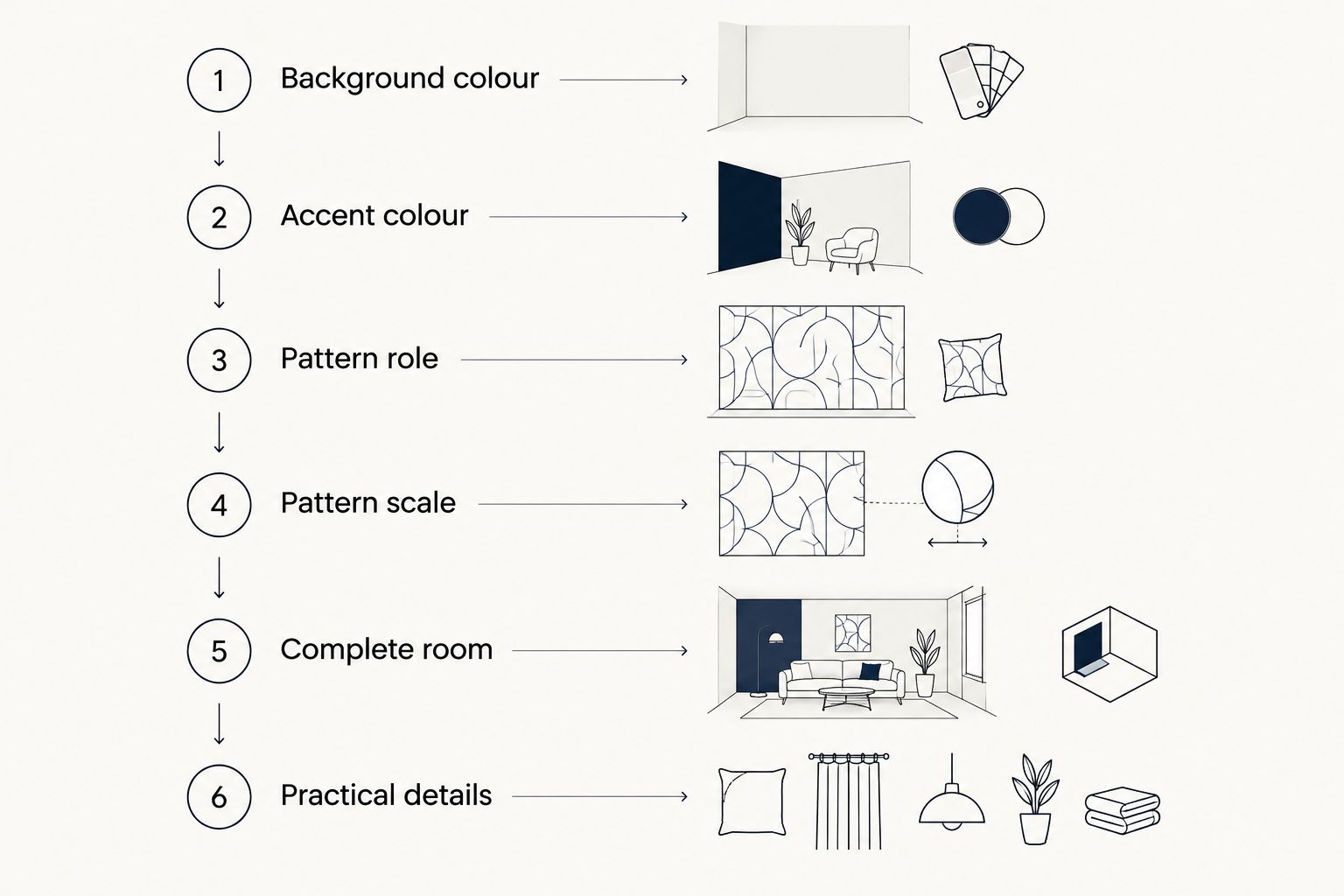
Work from the largest patterned piece, usually the sofa, upholstered chair or bedspread. Follow this sequence before choosing your fabric:
- Find the background colour. Look behind the flowers, checks or other motifs. This is a useful starting point for quieter curtains.
- Pick an accent colour. Choose a colour already present in the upholstery if you want the window to feel more noticeable.
- Choose the pattern role. Decide whether the curtains should provide a plain backdrop, gentle texture or a second visible print.
- Compare pattern scale. If both surfaces are patterned, avoid choosing motifs that look almost the same size and density.
- Check the complete room. Include the rug, wall colour, cushion covers and any bedding visible from the doorway.
- Confirm practical details. Check dimensions, fabric composition, heading style, privacy needs and the item's own care instructions.
Keep your upholstery reference beside the curtain image while shortlisting. A close-up photograph helps you remember the colours, although a screen is not a reliable substitute for seeing fabric in the room.
Which curtain style works best with your furniture?
Plain curtain fabric is the simplest recommendation when the upholstery already carries a strong pattern. It gives you a colour connection without introducing another motif. Patterned curtains remain an option, but they need a clearer relationship with the furniture.
| Curtain approach | Best for | Main advantage | Main drawback |
|---|---|---|---|
| Plain colour | Busy floral, checked or multicoloured upholstery | Repeats a colour without adding another print | A close but incorrect shade can still look mismatched |
| Subtle texture | Patterned furniture that needs a quiet backdrop | Adds surface interest without a distinct motif | Texture alone does not establish privacy or light control |
| Contrasting-scale pattern | Rooms where you deliberately want mixed prints | Creates variety while retaining a shared colour | Similar pattern sizes can compete |
| Sparse embroidery | Furniture with room for a small decorative detail | Keeps much of the curtain visually quiet | Embroidery and borders still count as pattern |
Treat these as styling choices, not performance categories. A plain curtain is not automatically opaque, and a textured curtain is not automatically heavy. Check the actual fabric description rather than judging function from appearance.
Plain curtain fabric: best for busy upholstery
Start with plain curtains when your sofa has dense flowers, several colours or a strong geometric design. Pick the upholstery background for a quieter result, or repeat a smaller accent colour to make the window more prominent.
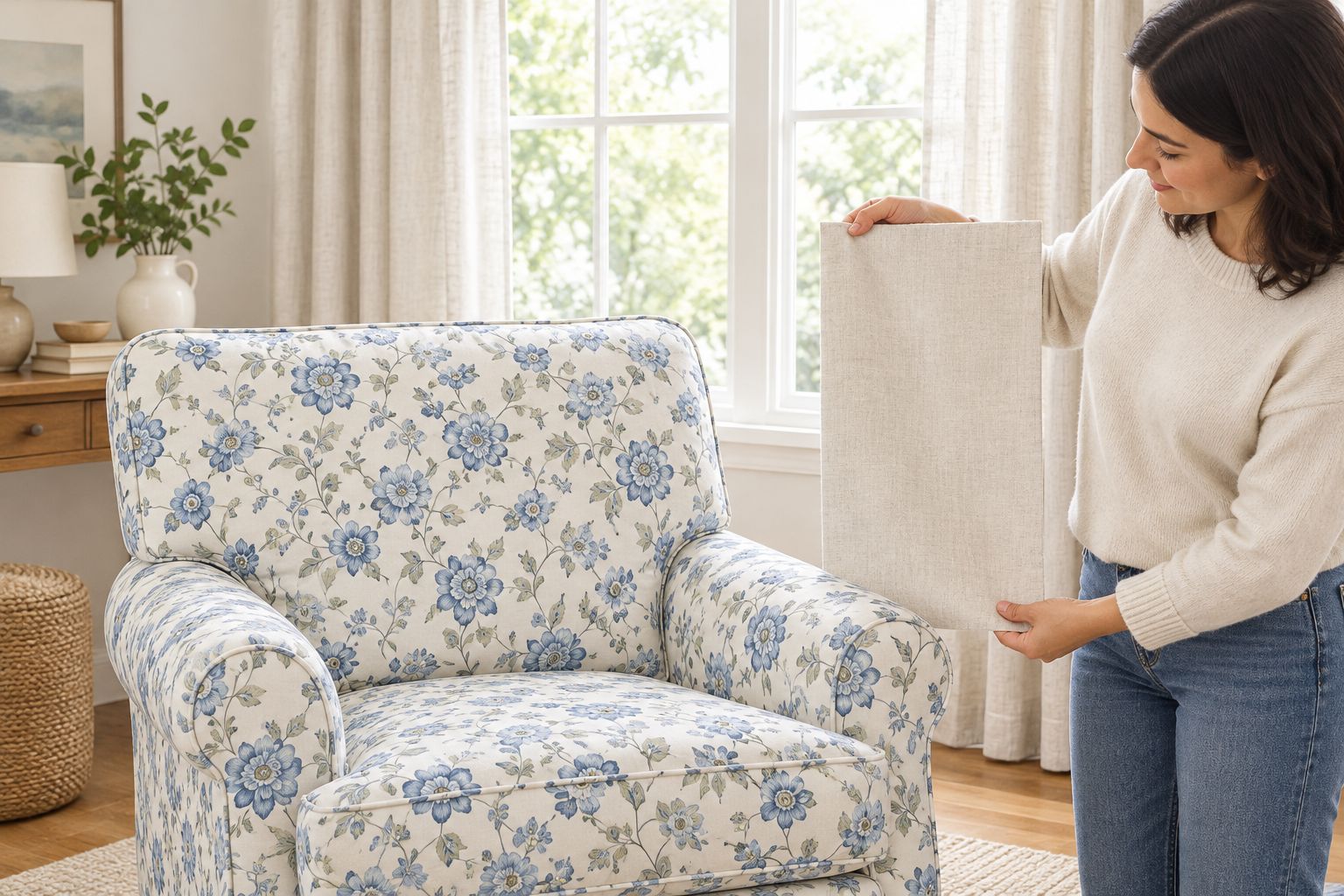
For example, with a cream-ground sofa carrying blue flowers and green leaves, compare cream, blue and green fabric references beside the seat. These are styling possibilities, not a requirement to use every colour. Choose the relationship you prefer and leave the others on the furniture.
The drawback is that plain fabric exposes shade differences. A cool white curtain beside warm cream upholstery can look disconnected even though both seem neutral when viewed separately.
For your 2026 shortlist, describe the shade more precisely than simply white or beige. Note whether it looks warm, cool, yellowish, greyish or pinkish beside the furniture.
Textured curtain fabric: best for a quieter layered look
Choose texture when you want more interest than a flat colour but do not want another obvious print. Compare the fabric both close up and from your usual seat; the surface detail should support the furniture rather than distract from it.
A woven-looking surface and a printed imitation of texture are not the same thing. Read the composition and construction details provided for the individual item. Do not infer natural fibre content from words such as rustic or linen-look.
Texture also does not tell you how a curtain will behave at the window. Confirm whether you need lining and ask about opacity if the description does not settle your privacy needs. Choose texture for appearance; verify performance separately.
Patterned curtain fabric: best for deliberate print mixing
Mix prints by giving them a shared colour and a different visual rhythm. A broad floral upholstery pattern and a restrained narrow stripe create a different relationship from two equally dense floral prints.
The useful distinction is not simply floral versus geometric. Look at motif size, spacing and contrast. Two different motifs can still compete if they occupy the same amount of visual space and are equally bold.
Keep other nearby surfaces quieter while you assess the combination. If the rug, sofa, curtains and cushions all have prominent prints, remove a movable patterned accessory before assuming the curtains are wrong.
The benefit of mixed prints is a room that feels personal rather than matched as a set. The drawback is that each additional pattern needs checking against the whole room, not just against the sofa.
Embroidered curtains: best for a small decorative connection
Sparse embroidery can echo a colour in your furniture without covering the whole window in print. Borders matter too: lace, contrasting edges and repeated embroidered flowers all contribute to the finished appearance.
One relevant example is Pulpel's white cotton door curtain with pink floral embroidery and lace border. Its listed 4 × 7 ft size and named decorative details give you specific features to compare with your doorway and upholstery. Consider it where a white ground and pink floral detail suit the existing room, not simply because the furniture also has flowers.
Read the 4 ft and 7 ft dimensions as a size to verify, not proof that the curtain will fit your opening. Confirm dimension order, heading details and how much coverage you need. This is a finished door curtain, so do not treat its dimensions as running-fabric yardage.
Why the right curtain choice varies between rooms
The same curtain can suit one room and feel misplaced in another. Check these factors before making your final choice:
- Pattern density: Closely packed upholstery motifs leave less visually quiet space than widely spaced motifs.
- Colour contrast: A small dark motif on a pale ground can attract more attention than a larger, low-contrast design.
- Existing textiles: Rugs, chair covers, cushions and bedspreads belong in the comparison, even when you are only replacing curtains.
- Window position: Judge the curtain from the sofa and doorway, not only while standing beside the window.
- Daily use: Decide whether the opening needs privacy, easier access, light filtering or additional lining.
- Care requirements: Choose an item whose stated care instructions fit your household routine.
For a Kerala family sitting room, include the chair covers and everyday cushion arrangement in your check. Removing them for a styling photograph gives you a different picture from the room you actually use.
How do you check colour and pattern at home?
Place your fabric reference upright near the window rather than leaving it flat on a table. Curtains hang vertically, and folds change how much of a motif you see. Compare it with the upholstery from your normal sitting position.
Check the combination in daylight and again with your usual lamps switched on. Keep the wall and floor visible during the comparison. A colour that seems right against the sofa alone still needs to sit comfortably with those larger surfaces.
For a 2026 online purchase, keep a simple note beside each shortlisted curtain: colour connection, pattern relationship and practical questions. That prevents an attractive product photograph from displacing the requirements you started with.
How do you measure before ordering curtain fabric?
Measure the installed curtain rod or track and the intended finished drop. Record width and drop separately, using the same unit throughout. Do not copy the dimensions of the glass when the curtain needs to cover a wider area.
If you are buying running fabric, the fabric width is not the finished curtain width. For example, a listing marked 60 inch wide describes the material's width, not the coverage of a stitched curtain. Fullness, seams, hems and pattern matching affect how much material the maker needs.
Ask your curtain maker to calculate the quantity from the actual fabric and heading you choose. Directional motifs and repeating designs need particular attention so that adjoining panels align as intended.
Do not order cutting quantities from a styling photograph. For a 2026 curtain order, keep the measurements, selected heading and confirmed fabric details together before you approve cutting or stitching.
Can floral curtains go with a floral sofa?
Floral curtains can go with a floral sofa when colour links the fabrics and the flowers differ clearly in scale or spacing. A shared floral theme alone is not enough to make the combination work.
Compare the amount of empty background around each motif. If both fabrics are densely covered, try a plainer curtain reference before committing to the second floral design.
Should curtains match the sofa or the walls?
Curtains can connect with either the sofa or the walls; they do not need to match both exactly. Repeating an upholstery colour ties the textiles together, while a wall-related shade creates a quieter window backdrop.
Choose according to the surface you want to emphasise. If the furniture is the feature, keep the curtains less visually demanding.
FAQ
What's the safest curtain fabric choice for a patterned sofa?
Plain curtain fabric in a colour already present in the sofa is the simplest starting point. Check the shade beside the upholstery and confirm the fabric's practical details separately.
Can I mix striped curtains with floral furniture?
Striped curtains can work with floral furniture when a shared colour connects them and their visual scales differ. Avoid choosing stripes that compete with the floral pattern in both density and contrast.
Should my curtains match my cushions exactly?
Your curtains do not need to match your cushions exactly. Repeat a colour or a restrained detail, and let some surfaces remain plain.
How do I choose curtains when my sofa has lots of colours?
Choose a single colour from the sofa rather than trying to repeat the entire palette. Start with the background colour for a quieter result, then compare an accent colour if you want a stronger window feature.
Does cotton curtain fabric automatically provide privacy?
Cotton curtain fabric does not automatically provide privacy. Weave, thickness, construction and lining affect coverage, so check the individual item rather than relying on fibre content alone.
Can I use furnishing fabric sold for cushions to make curtains?
Do not assume cushion fabric is suitable for curtains. Confirm its intended use, width, drape, pattern direction and care requirements before asking a maker to calculate the quantity.
How should I wash curtains with embroidery or lace?
Follow the care instructions for the specific curtain, including its embroidery and lace. Do not apply a general cotton-washing routine to every decorated item.
One last thing
Before replacing curtains, temporarily remove patterned cushions and throws from the room. You might prefer the existing curtain-and-sofa combination once the smaller competing prints are out of view. Add accessories back individually and keep only the combinations you enjoy.
For your 2026 room refresh, save a photograph of the arrangement you settle on alongside your measurements. When browsing curtain fabric and other home textiles at Pulpel, use that record to keep colour choices connected to daily life at home.