

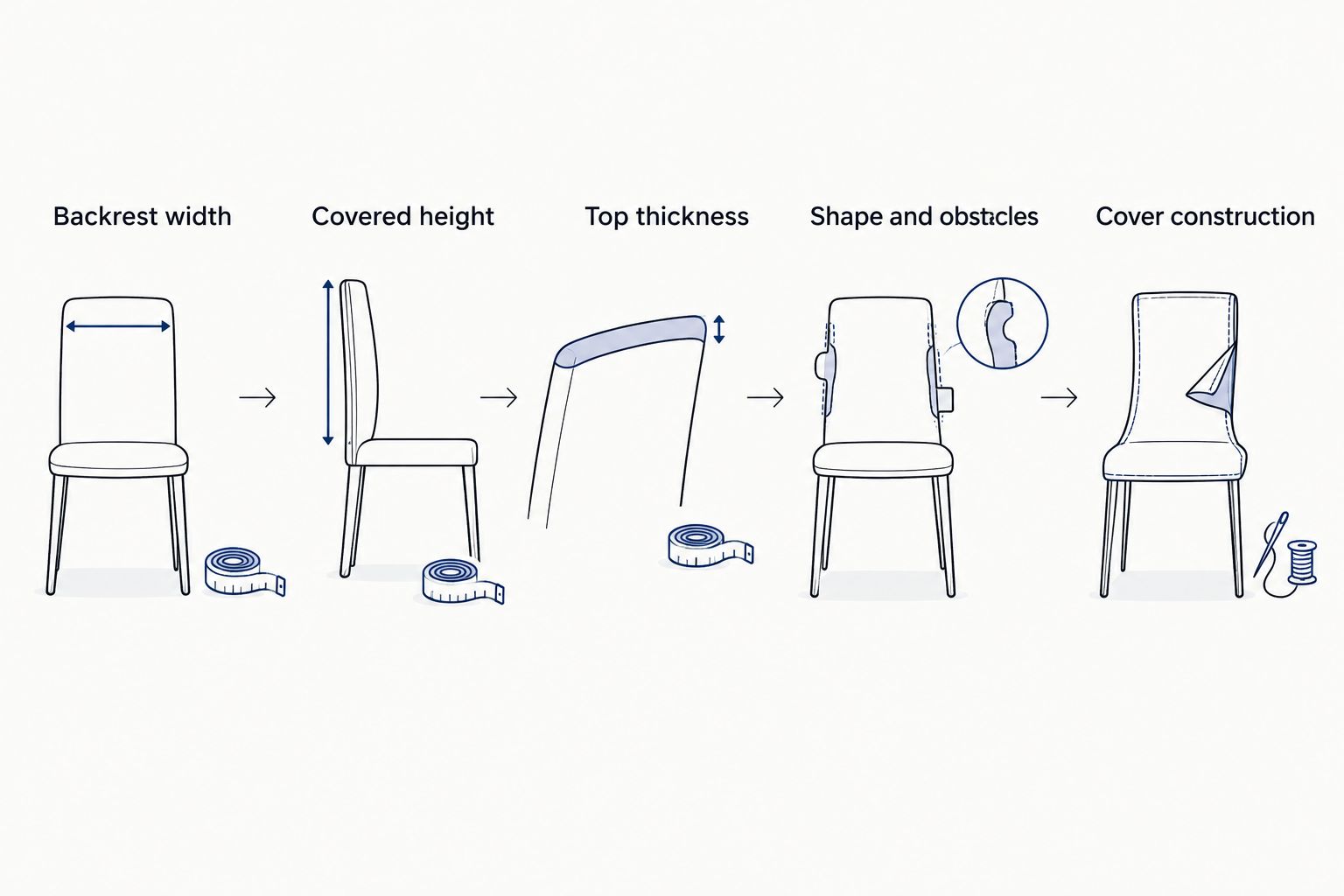
To measure chairs for chair back covers, record the backrest’s widest width, the height you want covered, and its thickness at the top. For a cover that slips over the backrest, also check the shape and any projections the opening must pass over. Match these measurements to the individual cover’s dimensions and construction; a decorative cloth laid over the back needs a different fit check from a sewn pocket.
- Measure chair back covers against backrest width, covered height and top thickness—not the chair’s overall height.
- Pulpel’s embroidered chair back covers suit shoppers seeking decorative home textiles; check each design’s dimensions before choosing.
- For pocket-style covers, confirm the opening accommodates the chair’s widest section and any projecting details.
- Keep chair measurements and cover dimensions separate, and compare them using the same units.
How do you measure chairs for chair back covers?
Measure the part of the chair the cover will actually touch, not the whole chair. Use a flexible measuring tape, a notebook and a clear view of the backrest. Move the chair away from the table so you can reach its front, sides and rear without twisting the tape.
For Pulpel chair back covers such as the White Embroidered Chair Back Cover Set, check the individual listing’s measurements and fitting details before choosing. The design name alone does not establish compatibility with your chair.
1. Measure the widest backrest width
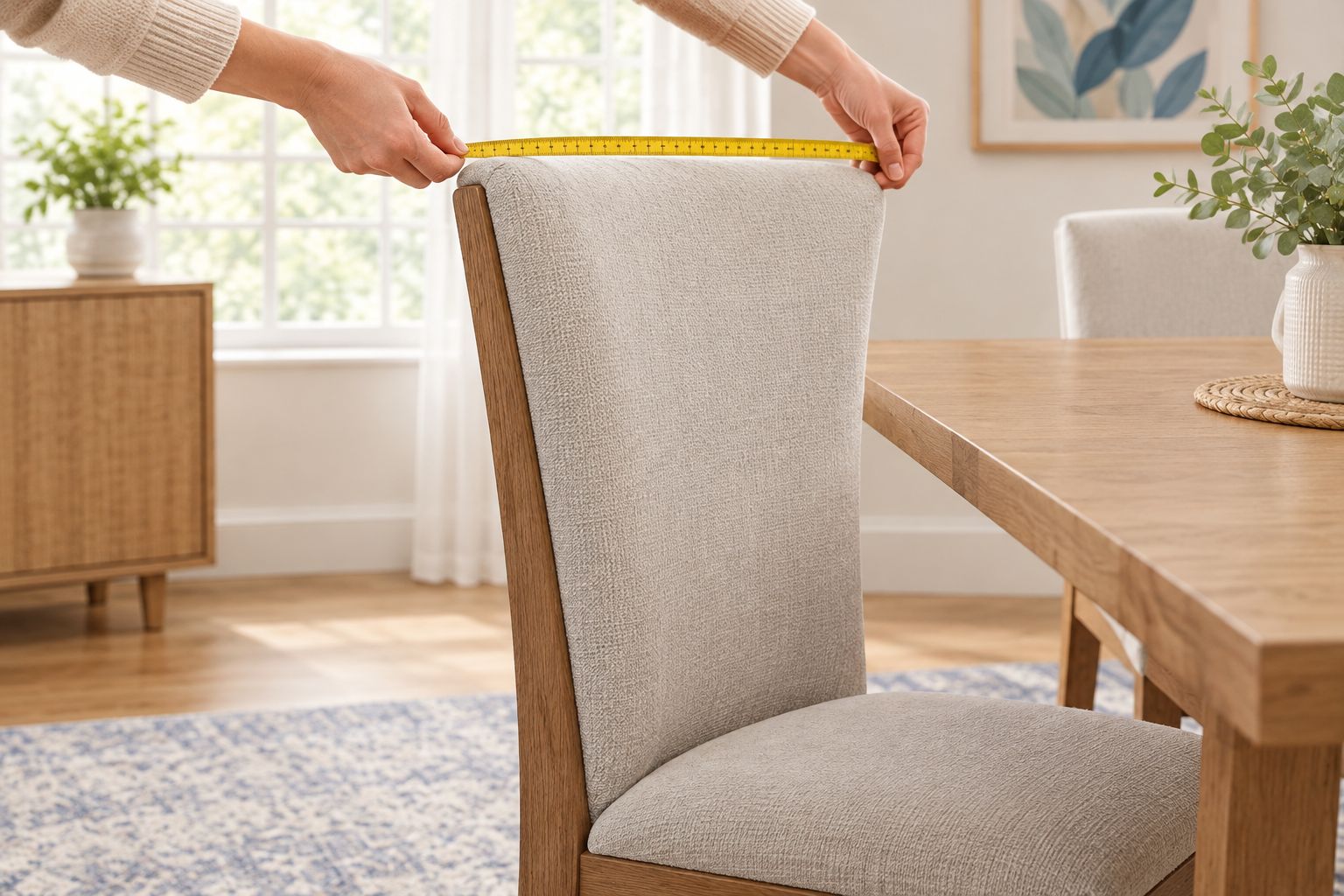
Place the tape across the backrest from its outer left edge to its outer right edge. Check the top, middle and lower area that the cover will reach, then record the widest part.
Keep the tape straight when measuring edge-to-edge width. If the backrest curves, record its surface measurement separately rather than treating a tape wrapped around the curve as the straight width.
Include frame edges, padding and decorative projections that sit within the covered area. A measurement between the inner edges of a wooden frame leaves out part of the chair the fabric must cover.
2. Measure the intended covered height
Start at the top of the backrest and measure down to where you want the cover’s lower edge to sit. Decide that position before measuring. A short decorative cover and a cover extending towards the seat need different lengths.
Do not use the floor-to-top chair height. That includes the legs and seat, which are irrelevant to a backrest-only cover.
For a cloth folded over the top, measure the intended front drop and rear drop separately. The fabric also travels across the top, so the front drop alone does not describe the total fabric length needed.
3. Measure the top thickness
Measure from the front surface to the rear surface at the top of the backrest. Check any padded roll, carved crest or thick frame section that a pocket-style cover must pass over.
Do not compress upholstery to obtain a smaller reading. Record the chair’s normal resting shape, because that is the shape the cover will sit on.
Thickness matters even when the chair looks narrow from the front. A cover can have enough visible width yet still fail to slide over a thick top rail.
4. Record the shape and obstacles
Write down whether the backrest is straight, tapered, rounded or curved. Note exposed finials, projecting corners, arms attached near the backrest and any other feature within the cover’s path.
Take a front photograph and a side photograph for reference. Keep the measurements alongside them so you can explain the chair’s shape when asking about fit.
5. Compare each measurement with the cover’s construction
Check whether the stated dimensions describe a flat fabric piece, the outside of a sewn cover or the usable opening. These measurements answer different questions.
Do not add a guessed allowance and call it a confirmed fit. Use the seller’s fitting guidance where it is provided. When a dimension is unclear, ask what was measured before ordering.
Why this matters
A chair back cover sits on a three-dimensional object, while an online listing can show only a flat measurement or a styled photograph. The missing connection is construction: where the fabric folds, where seams restrict movement and how the opening passes over the chair.
For your 2026 home-textile shopping, keep fit ahead of colour and embroidery. Choose the pattern after you know how the cover will sit; a pleasing design cannot correct an opening that is too narrow.
This is especially useful when preparing the dining area for Vishu or a family gathering. Measure the actual chairs you plan to dress, including any different end chairs, rather than assuming the whole group shares one shape.
Draped and pocket-style chair back covers: what changes?
A decorative cover laid over the top and a sewn cover slipped over the backrest require different checks. Identify the construction from the product details or ask for clarification; embroidery, lace and colour do not tell you how a cover attaches.
| Cover construction | Best for | Main measurement check | Practical advantage | Limitation |
|---|---|---|---|---|
| Draped cover | Shoppers wanting decorative coverage over the top of a backrest | Fabric width, front drop, rear drop and the path across the top | Placement is not restricted by a sewn pocket opening | Position depends on the chair surface and any fastening provided |
| Pocket-style cover | Shoppers wanting a cover that slips over the backrest | Usable opening, widest backrest section, thickness and covered height | The sewn shape defines how it sits on the chair | The opening must pass over projections and thick sections |
For a draped cover, check coverage; for a pocket-style cover, check entry as well as coverage. Neither construction is automatically right for every chair.
A flat piece can be repositioned, but it does not establish a secure hold by itself. A sewn pocket has a defined shape, but that shape must match the chair closely enough to sit without forcing the fabric.
Why chair back cover fit varies
Fit depends on the chair and the individual cover, not simply on a label such as “dining chair.” Check these physical factors before choosing:
- Backrest width: A backrest that widens below the top needs checking across the full covered area.
- Top thickness: Padding and thick wooden rails change the space a slip-over opening needs.
- Curvature: Fabric follows a curved surface differently from a straight edge-to-edge measurement.
- Projections: Carved details and finials can obstruct the opening even when the main backrest is narrower.
- Covered height: A longer drop reaches sections that a short decorative cover leaves exposed.
- Cover construction: Seams, openings and fastenings determine how the fabric sits; inspect the individual design.
Do not infer stretch from appearance. A smooth-looking fabric is not proof of elasticity, and a decorative border does not confirm where the usable opening begins or ends.
Which measurements should you write down?
Make a simple measurement record for each distinct chair shape. Keep actual chair dimensions in one column and the corresponding cover dimensions in another, so you do not accidentally compare a chair measurement with a guessed fabric requirement.
| Measurement record | What to write | What to compare it with |
|---|---|---|
| Widest backrest width | Outer edge to outer edge within the covered area | Cover width or stated fitting range |
| Intended front drop | Top of backrest to your chosen lower edge | Front coverage or relevant fabric length |
| Intended rear drop | Top of backrest to the chosen rear edge | Rear coverage for a draped design |
| Top thickness | Front to rear across the top section | Opening depth or fitting guidance |
| Shape and obstacles | Curves, taper, padding and projections | Construction photographs and fitting details |
For a 2026 measurement record, include the measurement date and a chair photograph. This keeps the record tied to the furniture you actually checked, especially if you later replace a chair or change its upholstery.
Leave an unclear cover dimension unresolved rather than filling the gap with an estimate. A short question about whether a measurement includes the border is more useful than choosing from an assumption.
Should you measure chair back covers in inches or centimetres?
Use whichever unit the product listing uses, and label every measurement. Never compare an inch measurement directly with a centimetre measurement. Convert first, then check the corresponding dimension.
These standard conversions keep your notes consistent:
- 1 inch equals 2.54 centimetres. Use this when the listing and your tape use different units.
- 1 centimetre equals 10 millimetres. This helps when recording a small thickness measurement.
- 1 metre equals 100 centimetres. Keep long fabric measurements in the same unit as the cover dimensions.
Keep the original reading beside any conversion. Avoid rounding down to make a chair appear to fall within a stated fitting range.
Your 2026 shopping notes should identify both the unit and the measurement direction. “Width in centimetres” is clearer than an unlabelled number, particularly when several family members help with the measurements.
How do you measure a curved or padded chair back?
Measure a curved or padded chair back in its normal shape, without flattening the curve or squeezing the padding. Record straight width, surface shape and thickness separately.
For a curved backrest, a tape stretched between the outer edges records straight width. A flexible tape following the front surface records a different path. Explain which reading you have taken when checking suitability with the seller.
For a padded backrest, inspect the top roll and any wider upholstered sections below it. Measure the part that the cover must pass over, not just the narrowest area where you expect it to settle.
Do you need to measure every chair in a matching set?
Check every chair in the group, and record separate measurements wherever the shape or size differs. Matching colour or upholstery does not establish identical dimensions.
Look especially at end chairs, chairs with arms and replacements added later. If all the chairs genuinely share the same dimensions and construction, one clearly labelled record can describe that matching group.
Also check the contents of the cover set. Do not treat a set description as proof that every included piece has the same dimensions or that it matches your furniture arrangement.
What should you check before ordering?
Pulpel chair back covers are a relevant choice for shoppers seeking embroidered home textiles; individual measurements determine suitability. Start with the fit details, then consider how the design will look beside your curtains and table linen.
Use this 2026 buying checklist before placing an order:
- Confirm the stated dimensions and whether decorative borders are included.
- Identify the cover’s construction and any fastening described.
- Check the usable opening when the design slips over the chair.
- Read the set contents rather than assuming the number or type of pieces.
- Check the material and care instructions for that specific item.
- Resolve unclear fitting details before choosing the design.
Do not assume every embroidered cover uses the same fabric or washing method. The same caution applies to shrinkage: use any stated product guidance, rather than adding an unsupported percentage to your measurements.
After washing, follow the item’s drying and ironing instructions before refitting. Avoid pulling hard on lace or embroidery to overcome a fit problem; those decorative details are not a substitute for the correct dimensions.
FAQ
How do I measure my chair for chair back covers?
Measure the backrest’s widest width, your intended covered height and the thickness at the top. For a slip-over cover, also check the opening against the chair’s shape and projections.
Do I measure the full chair height for a chair back cover?
No, measure the backrest area the cover will occupy, not the height from the floor. Chair legs and seat height do not establish the length needed for a backrest-only cover.
Should I add extra fabric allowance to my chair measurements?
Record the chair’s actual measurements first and use the individual cover’s fitting guidance for any allowance. Do not add a guessed allowance to a finished cover’s stated dimensions.
Can the same chair back cover fit wooden and padded chairs?
Compatibility depends on the measurements and construction, not whether the chair is wooden or padded. Check the thickest section and any projections a sewn opening must pass over.
What if the chair back is wider at the bottom than at the top?
Measure the widest section within the area the cover will reach. For a pocket-style cover, confirm that its opening and body accommodate the chair’s tapered shape.
Are chair back covers the same as full chair covers?
No, chair back covers are intended for the backrest rather than the whole chair. Check the listing’s coverage and set contents instead of assuming it includes seat or leg coverage.
Can I wash every embroidered chair back cover the same way?
No, follow the material and care instructions for each individual cover. Embroidery alone does not establish whether machine washing, a particular temperature or a specific drying method is suitable.
One last thing
The part where a cover rests is not always the part it must pass over. A narrow lower backrest can still have a thick or projecting top that blocks a sewn opening.
Before choosing chair back covers from Pulpel in 2026, trace that fitting path with your hands. Check the top, the widest section and the intended lower edge; this simple final check catches a problem that a single front-facing width measurement misses.