

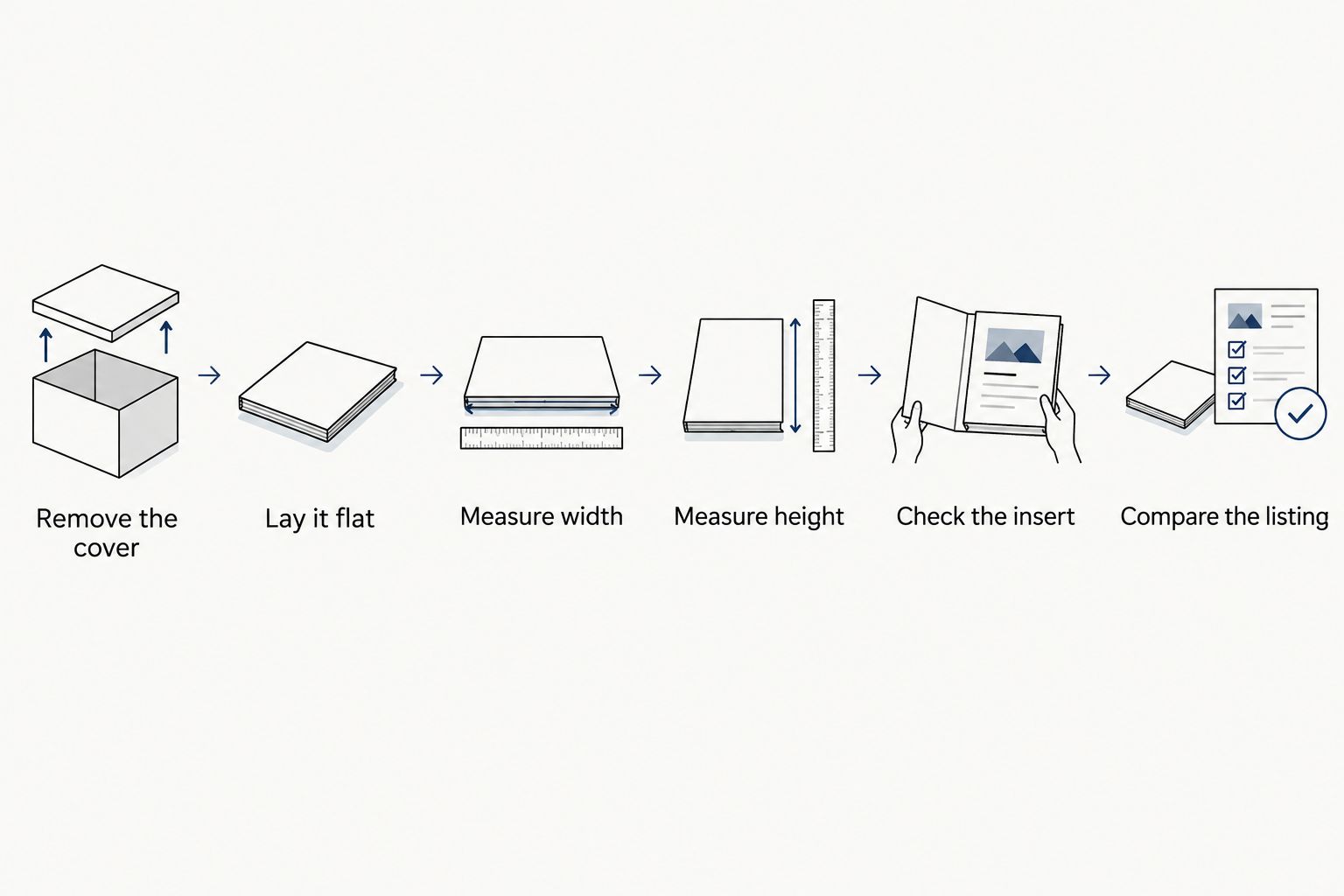
To measure for cotton cushion covers in 2026, remove the existing cover, lay it flat without stretching, and measure between the stitched seams across its width and height; then check those dimensions against the cushion insert and the new cover’s size description. Decorative borders, a rounded filling and unclear size labels can give you the wrong measurement, so confirm what the seller’s dimensions describe before ordering.
- For cotton cushion covers, measure stitched width and height rather than the cushion’s rounded surface.
- A 16-inch side equals 40.64 cm; keep cushion measurements and listing dimensions in the same unit.
- Nushio by Pulpel home textiles suit family shoppers; confirm cushion-cover composition and sizing on each listing.
- Check the insert, closure and care instructions before choosing a replacement cushion cover.
How do you measure cushions before buying cotton cushion covers?
Start with the cover that already fits your cushion well. Its flat, seam-to-seam dimensions give you a useful reference, while the insert helps you check whether that reference still makes sense.
Nushio by Pulpel lists a 16 × 16-inch feather-design cushion-cover set of 5. That gives you a stated size to compare with your measurements, but the size and design alone do not establish fabric composition, closure type or washing instructions. Check those details separately when shopping for cotton cushion covers.
Remove the existing cover
Open the zip, buttons or envelope opening and take out the insert gently. Do not pull the filling through an opening that is caught or partly closed.
If the cover is sewn permanently onto the cushion, do not cut it open just to measure. Measure between its seams as carefully as possible and describe the cushion’s construction when asking for sizing advice.
Lay the cover flat
Place the empty cover on a table or another level surface. Smooth out folds with your hands, keeping the fabric relaxed rather than pulling the corners outward.
Align the front and back panels so the edges sit naturally. A twisted cover gives you a less useful reference, especially if it has piping or an overlapping back opening.
Measure the width
Run the tape straight across the cover from one side seam to the opposite side seam. Keep the tape flat and read it at the stitched edge, not at the outer edge of a frill or lace border.
Write down the width immediately, including the unit. A note that says only the number is easy to misread later when you compare listings.
Measure the height
Measure between the top and bottom seams in the same way. Record both dimensions, even when the cushion looks square.
Do not use a diagonal measurement or wrap the tape around the cushion. Neither gives you the flat width and height needed for an ordinary replacement cover.
Check the insert
Look at the insert’s size label if it has one, then compare it with the old cover. Without a label, measure between the insert’s opposite seam edges, keeping the tape straight rather than following the rounded filling.
Do not squeeze the insert heavily to make a preferred size appear to fit. Note whether it already sits comfortably inside the old cover or leaves empty corners.
Compare the listing
Check whether the seller’s dimensions refer to the finished cover or the recommended insert. Also confirm whether the item is a cover only or includes filling.
For your 2026 shopping note, keep the cover dimensions, insert information and preferred fit together. That gives you something clear to compare rather than relying on a photograph.
Why this matters
A cushion cover needs to fit the filling you already have, not just suit the colour of your sofa. Excess fabric leaves loose corners; an overly tight fit puts strain on the seams and makes the closure harder to use.
Measuring also separates a sizing problem from a filling problem. If an old insert has become uneven, changing the cover alone does not restore its shape.
For a family sitting room, choose a cover you can remove without struggling. A useful everyday purchase starts with fit and care requirements, whether you are refreshing the room for Vishu or replacing a worn cover.
Which measurement should you trust?
Use a well-fitting empty cover as your starting reference, then check the insert. An old cover that already pulls at the seams or hangs loosely is evidence of a fit problem, not a reliable template for your next purchase.
| Measurement reference | Best for | Advantage | Limitation |
|---|---|---|---|
| Empty, well-fitting cover | Replacing a cover while keeping the same insert | Shows the existing finished dimensions | Washing or wear can have changed its shape |
| Insert size label | Checking a clearly labelled insert | Gives the stated insert dimensions | Does not tell you the new cover’s recommended fit |
| Insert seam-to-seam measurement | Checking an unlabelled insert | Gives a direct physical reference | Rounded filling makes careful positioning important |
| Covered cushion measured in place | An initial check when removal is difficult | Requires no dismantling | Measuring over the dome does not give flat cover dimensions |
If these references disagree, stop before choosing a size. Check the tape position, read the labels again and inspect whether the old cover has stretched or changed shape.
For an online order in 2026, a clear question is more useful than a guess: explain your measured cover size and insert label, then ask which dimensions the listing uses. Keep the answer with your measurements.
How do you measure a square cushion?
Measure the square cover’s width and height separately between the stitched seams. Both sides should be checked; appearance alone does not prove they are equal.
The listed 16 × 16-inch size corresponds to 40.64 × 40.64 cm, using the standard conversion of 1 inch = 2.54 cm. This is a unit conversion, not a promise that every item with that label has identical finished measurements.
Keep your comparison in one unit throughout. If your tape uses centimetres and the listing uses inches, convert the dimensions before deciding whether they match.
Do not automatically choose a smaller cover to make a square cushion look fuller. The right pairing depends on the insert and the cover maker’s sizing guidance, not a universal rule.
How do you measure a rectangular cushion?
Measure the rectangular cover’s longer and shorter sides separately. Record which is which, especially when a directional print has a clear top and bottom.
A rectangular cushion is not measured by doubling one side of a square cushion. Its width and height both need to match the relevant listing dimensions.
For a shaped cushion with a gusset, record the depth separately as well. If the cover has a distinct side panel, ordinary flat-cover sizing does not describe the whole construction; ask whether the replacement accommodates that panel.
How do you measure a round cushion or bolster?
For a round cushion, measure straight across the centre between opposite stitched edges. Do not run the tape around the outside and treat that measurement as the diameter.
For a cylindrical bolster, record the length and the measurement around its body. Check whether the seller asks for circumference or diameter before comparing sizes.
Round cushions and bolsters need covers made for their shape. A square-cover listing does not establish that it will fit either, even if a dimension looks similar.
Why cushion-cover fit varies
A size label is the beginning of the comparison, not the whole answer. These practical factors explain why the fit you see at home can differ from the fit shown in a photograph:
- Measurement reference: Finished-cover dimensions and recommended insert dimensions describe different things. Confirm which the listing gives.
- Filling shape: A plump insert and a flattened insert do not fill the corners in the same way. Inspect the filling before replacing the cover.
- Cover construction: Piping, a gusset, an envelope back or a zip changes how the cover opens and sits around the insert.
- Fabric and finishing: Cotton and cotton blends are not interchangeable descriptions. Check the stated composition rather than assuming stretch or care behaviour.
- Condition of the old cover: Wear and laundering can change an existing cover’s shape. Compare it with the insert rather than copying its measurements unquestioningly.
- Preferred appearance: Decide whether you want a relaxed fit or a fuller appearance, then check the seller’s guidance. Appearance should not require forcing the closure.
When choosing cotton cushion covers in 2026, treat an attractive photograph as a design reference. Your measurements and the product details determine the fit.
What should you check besides cushion size?
Once the dimensions make sense, check how the cover will work in your household. Nushio by Pulpel is best for family shoppers choosing everyday home textiles. For cushion covers, however, suitability still depends on the individual item’s fabric, sizing and care details.
The listed cushion-cover set provides a named design, dimensions and set quantity to compare. Those details do not answer every buying question, so confirm the following before ordering:
- Composition: Check whether the listing explicitly says cotton, cotton blend or another material.
- Contents: Confirm whether you are buying covers only, and how many your selected option includes.
- Opening: Check how you insert and remove the cushion, including any closure instructions.
- Care: Read the product-specific washing, drying and ironing guidance.
- Decoration: Check whether embroidery, lace or other trims need particular handling.
Cotton describes a fibre, not a complete washing instruction. Avoid treating all cotton cushion covers as machine-washable or suitable for the same drying method.
How do you check the fit when the cover arrives?
Compare the label and dimensions with your saved measurements before fitting the cover. Follow any instructions supplied with that particular item.
Guide the insert into the corners gently and distribute the filling evenly. If you must bend a zip sharply, stretch the opening or pull hard on a seam, stop rather than forcing it closed.
Once fitted, look for empty corners, twisted seams and uneven tension. Remove and reposition the insert if it has folded inside; do not assume every crease means you ordered the wrong size.
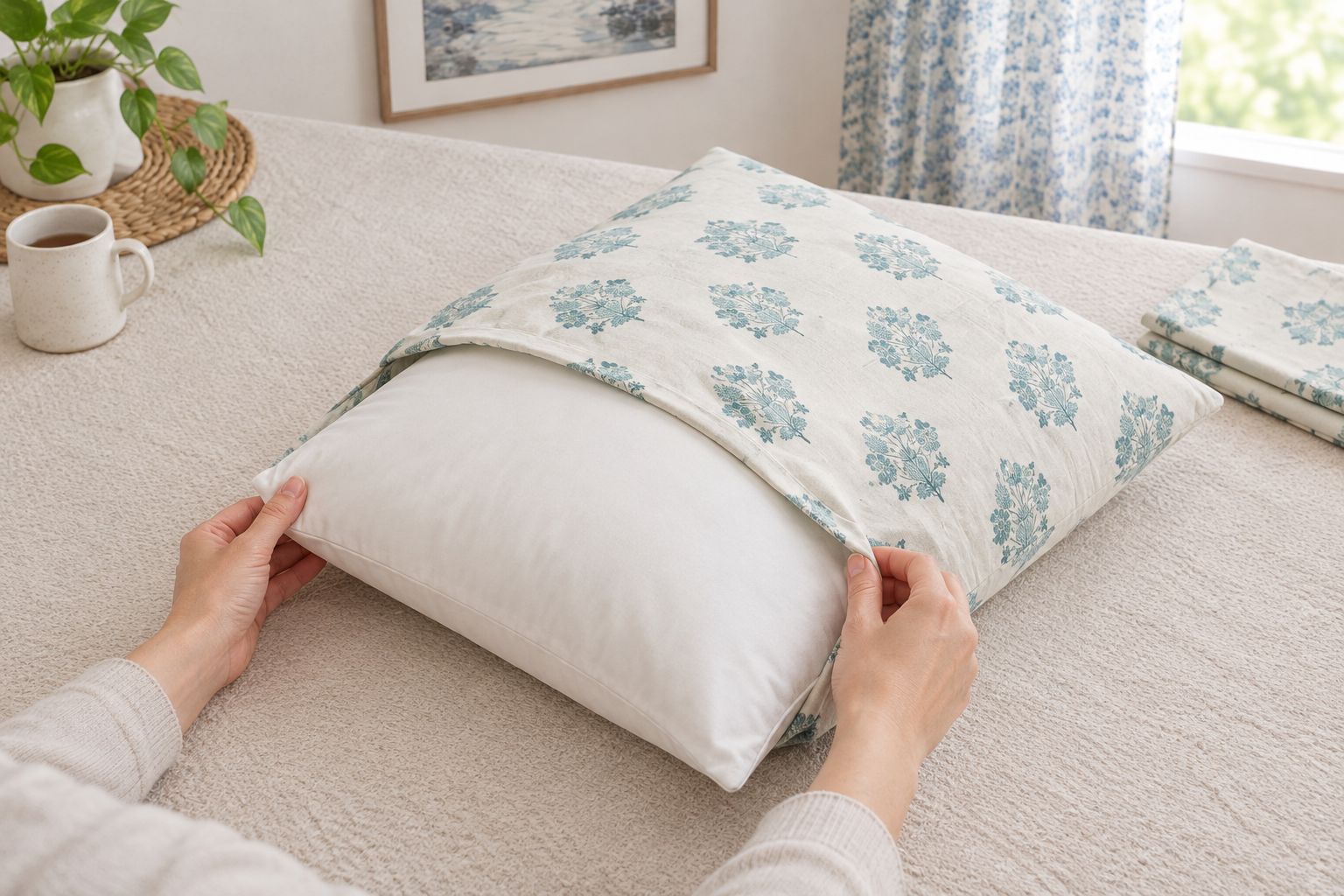
A loose fit and a tight fit need different checks. For looseness, compare dimensions and filling condition; for tightness, check the size pairing and whether the insert is caught or folded.
Should cushion covers be smaller than the insert?
A 16 × 16-inch cover does not, by itself, establish which insert size the seller recommends. Some cover-and-insert pairings are intended to look fuller, but you should follow the guidance for the actual items you are combining.
Choose by confirmed compatibility, not by subtracting an assumed allowance. A decorative preference is not a reason to strain seams or force a closure.
Should you wash cotton cushion covers before measuring them?
Measure your existing cover in its normal, clean and fully dry condition. For a new cover, check its care instructions before washing; do not wash it simply to make it fit.
Keep your 2026 measurement record as a reference for later replacements. If laundering changes the fit, compare the dry cover with that record and inspect the insert separately.
FAQ
How do I measure my cushion for cotton cushion covers?
Measure the empty, well-fitting cover between its stitched seams across both width and height, then check the insert. Keep decorative borders outside the measurement unless the seller explicitly includes them.
What is a 16-inch cushion cover in centimetres?
A 16-inch side equals 40.64 cm, so 16 × 16 inches converts to 40.64 × 40.64 cm. Confirm whether the listing describes finished-cover dimensions or the recommended insert size.
Should I measure the cushion with its cover on?
Measure the empty cover when you can remove it. A tape following the rounded surface of a filled cushion does not give the flat cover’s width and height.
Should I buy a smaller cover for a fuller cushion?
Do not automatically buy a smaller cover for a fuller cushion. Check the cover maker’s insert recommendation and avoid a pairing that requires forcing the closure.
Do cotton cushion covers always have the same washing instructions?
Cotton cushion covers do not all have the same washing instructions. Follow the individual label because composition, trims and construction need separate checks.
Does a cushion-cover set include the filling?
Do not assume a cushion-cover set includes filling. Check the listing’s contents and selected option before ordering.
What should I check on Nushio by Pulpel cushion-cover listings?
Check the stated dimensions, fabric composition, set contents, closure and care guidance on Nushio by Pulpel cushion-cover listings. A size and design name alone do not establish every product detail.
One last thing
Before replacing a loose-looking cover, check the insert’s corners. A folded or uneven filling needs repositioning; a new cover alone does not fix it.
Save a simple note with width, height, unit, insert label and care instructions. When browsing Nushio by Pulpel home textiles, that small record keeps your next purchase grounded in the cushion you actually own.