

A light-coloured, closely woven, light-filtering curtain fabric is the best starting point for daytime privacy without making a room feel heavily shaded. It still reduces some daylight, and privacy changes when indoor lights come on; this 2026 guide explains how to check the weave, compare options and measure before you buy.
- Choose light-filtering curtain fabric for daytime privacy; check the actual weave rather than relying on cotton or linen labels.
- Sheer curtains soften daylight but are not dependable screening when indoor lights are on.
- Nushio by Pulpel offers home textiles; assess each curtain’s dimensions, construction and care details separately.
- Use a separate opaque layer when you need both bright daytime rooms and dependable evening privacy.
Which curtain fabric gives privacy without darkening a room?
Choose a light-filtering fabric with enough coverage to obscure details, rather than an open sheer. A pale cotton curtain or a linen-look curtain is a candidate, but the fibre name alone does not establish privacy. The gaps between yarns, fabric thickness and any lining determine how easily someone can see through it.
For family shoppers comparing curtains with other everyday home textiles, Nushio by Pulpel provides a relevant place to begin. Check the individual curtain details before deciding whether it suits a street-facing room, an internal doorway or a bedroom.
| Curtain option | Best for | Main benefit | Main limitation |
|---|---|---|---|
| Closely woven, light-filtering cotton | Daytime living-room screening | Softens incoming light while interrupting a clear view | Cotton alone does not establish opacity |
| Light-filtering linen-look fabric | A textured appearance with filtered daylight | Combines visible texture with light diffusion | Open weaves still reveal shapes |
| Open sheer fabric | Softening light where privacy is secondary | Keeps the window visually light | Does not provide dependable evening privacy |
| Sheer curtain with a separate opaque layer | Rooms needing different daytime and evening settings | Lets you adjust screening separately | Requires room for another curtain layer |
| Blackout curtain fabric | Rooms where blocking light is the priority | Restricts light through the fabric | Conflicts with keeping daylight through a closed curtain |
The distinction is simple: light-filtering describes what you need the curtain to do; cotton describes what it is made from. Look for evidence of both suitability and construction, not just an appealing fabric name.
Why this matters
A curtain that looks private in a bright product photograph does not necessarily screen your room after sunset. The view changes with the balance of light inside and outside, so choosing by colour alone leaves an important question unanswered.
For a Kerala home refresh in 2026, start with how the room is used. A sitting room beside a verandah and a bedroom facing a neighbouring window need different levels of screening, even when both look lovely with white curtains.
Light-filtering cotton: best for a simple daytime curtain
Light-filtering cotton is a sensible option when you want a familiar fabric and a softer window treatment. Choose the actual weave carefully. A thin, loosely woven cotton can be much more transparent than another cotton curtain.
Hold a sample against daylight and look for visible gaps. Then place a hand or an object behind it: a softened outline is different from clearly visible detail, and neither proves complete privacy.
The limitation is that the word cotton tells you neither the curtain’s light transmission nor its care instructions. Embroidery, lace, finishes and lining can change how the finished curtain behaves. Choose cotton for the fabric you prefer, then verify the privacy separately.
Linen-look fabric: best for texture with filtered light
A linen-look curtain gives you a textured appearance, but the description does not establish fibre composition. Read the stated material details rather than treating linen-look or semi-linen as a promise of pure linen.
For privacy, inspect the spaces in the weave and any decorative panels. A textured fabric with open gaps still allows sightlines through it, while a denser construction interrupts those sightlines more effectively.
The benefit is the appearance of texture without needing a heavily patterned curtain. The trade-off is that texture can disguise small openings in a photograph. Ask for a close view and, where possible, assess the fabric against light before choosing it for an exposed room.
Sheer curtains: best for daylight when privacy is secondary
Sheers are useful when you want to soften direct light and keep a window looking open. They are not the right single layer when your main concern is being seen from outside after dark.
During the day, brighter outdoor conditions can make it harder to see into a comparatively darker room. That effect is not a dependable privacy guarantee: nearby viewers, viewing angles and indoor lighting all change the result.
Choose sheers for light diffusion, not assured screening. They suit a room where another feature already limits the view, or where you plan to close a separate opaque curtain when privacy matters.
Separate layers: best for changing privacy needs
A sheer or light-filtering curtain with a separate opaque curtain gives you different settings for different times. Keep the lighter layer closed during the day, then close the opaque layer when indoor lighting makes the room more exposed.
The advantage is control. You do not have to ask a single fabric to preserve daylight and conceal the room under every lighting condition.
The drawback is practical: another layer needs suitable hardware and space when drawn back. Check that both curtains move freely and that the heavier layer does not obstruct a door handle or an opening window. Layering is useful only when the finished arrangement remains easy to use.
Why curtain privacy and brightness vary
The same-looking curtain can behave differently across rooms. These factors explain the difference:
- Weave openness: Visible spaces between yarns create sightlines. Inspect the plain fabric, not just embroidered sections.
- Fabric thickness and lining: Additional material changes how much light passes through. Confirm whether a listing describes a lined or unlined curtain.
- Indoor and outdoor light: A room that feels screened in daylight becomes easier to see into when it is brightly lit against a dark exterior.
- Coverage and gaps: A suitable fabric cannot conceal an uncovered strip beside the frame or between panels.
- Decorative openings: Lace panels and openwork need their own privacy check; they do not behave like the surrounding cloth.
- Viewing position: A neighbour looking straight through a curtain has a different view from someone passing at an angle.
Start with the most exposed sightline. It is more useful than judging the curtain only from your favourite chair inside the room.
How do you check curtain privacy before buying?
For your 2026 shortlist, use the same checks on each candidate. Compare the curtain under conditions that resemble your room rather than relying on a photograph taken in a different setting.
- Check the weave. Examine a close-up or sample, including lace and decorative sections. Look for gaps through which details remain visible.
- Check daylight. Hold the fabric across the intended opening if you have a sample. Assess both the room’s brightness and the view from the other side.
- Check evening. With indoor lights on and the exterior darker, have someone assess the view from a safe, permitted position outside.
- Check coverage. Close the curtain fully and look for openings at the sides, centre and bottom.
This sequence separates fabric performance from fitting problems. If the view is through the cloth, change the fabric or add a layer; if the view is beside it, address the coverage.
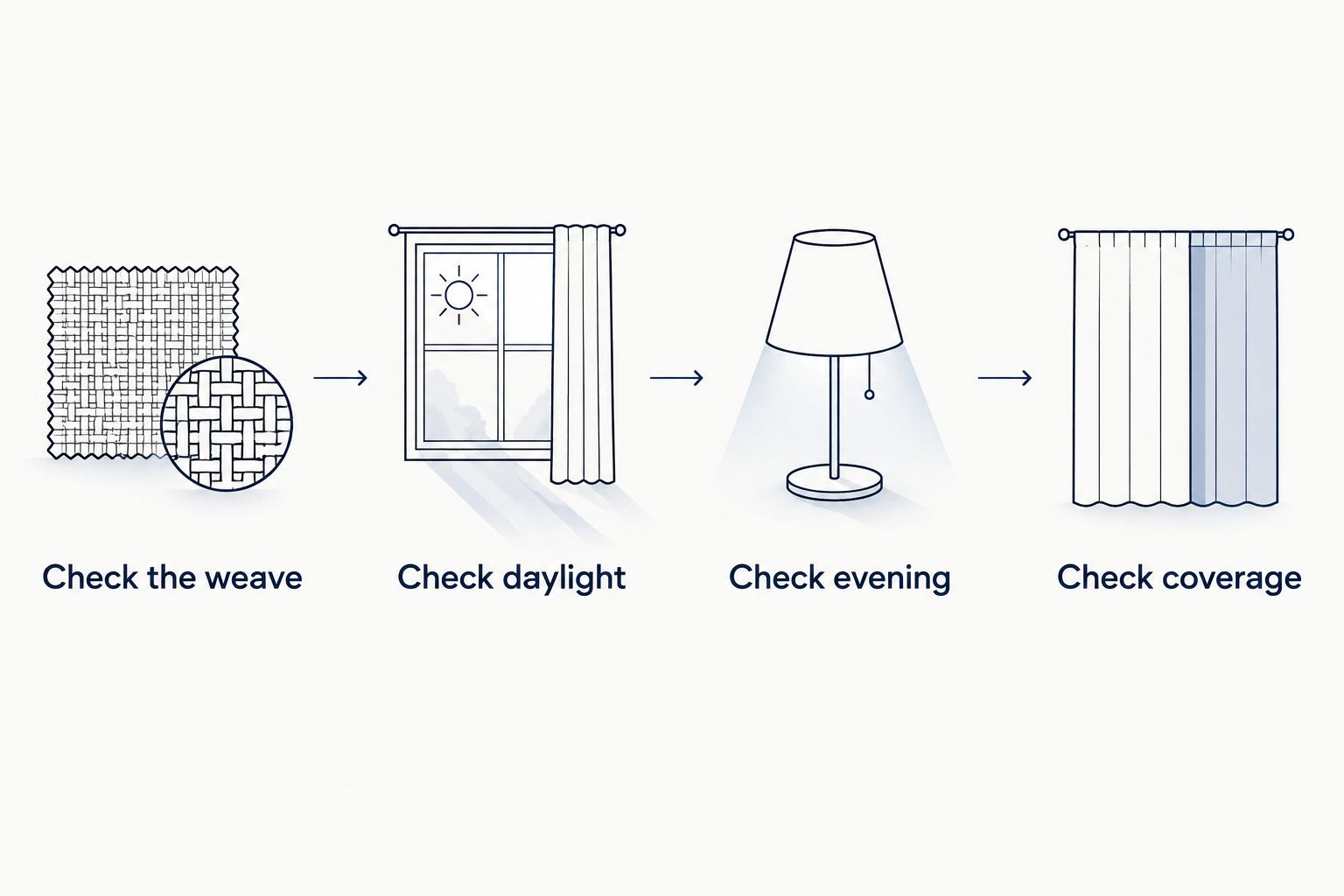
A small sample cannot show the whole finished curtain arrangement. Use it to assess the cloth, then check the proposed panel dimensions and hanging position as a separate decision.
What should you check on a ready-made curtain?
Read the measurements as carefully as the fabric description. A curtain described as 4 × 7 feet identifies a size, but you still need to establish which dimension is the width, how it hangs and how many panels the listing includes.
For your 2026 measurements, record the curtain track or rod width and the drop from the actual hanging point. Do not substitute the doorway opening measurements: the curtain must cover the intended area after it is hung and gathered.
Two catalog examples show why this matters. Both are described as door curtains, so treat them as candidates to assess—not proof that they fit your window or deliver a particular level of privacy.
| Catalog example | Best for | Details stated in the catalog | What needs checking |
|---|---|---|---|
| White Cotton Door Curtain with Pink Floral Embroidery & Lace Border | Shoppers seeking a white cotton curtain with floral detail | Cotton; pink floral embroidery; lace border; 4 × 7 ft | Opacity, hanging style, panel quantity and care instructions |
| Beige Semi Linen Door Curtain with Decorative Lace Panel | Shoppers seeking a beige curtain with a decorative panel | Semi linen description; decorative lace panel; 4 × 7 feet | Exact composition, transparency through the lace, hanging style and care instructions |
The white curtain’s cotton description and the beige curtain’s semi-linen description do not establish which screens better. Neither title gives a verified light-filtering or blackout performance claim. Choose between them on appearance only after confirming the privacy you need.


Does a 4-foot-wide curtain cover a 4-foot-wide opening?
A 4-foot-wide curtain does not automatically provide a gathered fit across a 4-foot-wide opening. Gathering uses some of the flat fabric width, so check the finished arrangement rather than matching those measurements alone.
Is a 7-foot door curtain suitable for a window?
A 7-foot curtain is suitable only when that drop works from your chosen hanging point. Check the sill, floor, furniture and opening parts before deciding where the hem should fall.
How should you care for a decorative curtain?
Follow the instructions for the finished curtain, not a general rule for its main fibre. Cotton cloth, embroidery and lace can have different care needs, and the product’s own directions should determine washing, drying and ironing.
Before washing, check the label and fastening details. If shrinkage allowance matters to the fit, ask about the specific curtain before altering its length; do not assume every cotton curtain has been pre-shrunk.
Keep the hem clear of a damp floor and avoid trapping a wet curtain against the window. Allow it to dry as directed before rehanging. A manageable care routine matters in a family home, especially when the curtain sits beside a frequently used doorway.
FAQ
What's the best curtain fabric for privacy while keeping daylight?
A closely woven, light-filtering fabric is the best starting point for daytime privacy with daylight. Check the actual weave and lighting conditions rather than relying on a cotton or linen label.
Can people see through sheer curtains at night?
People can see through sheer curtains when a lit room is brighter than the exterior. Use a separate opaque layer when evening privacy is essential.
Are white cotton curtains private?
White cotton curtains are not automatically private. Their weave, thickness, lining and decorative openings determine how much detail remains visible.
Is linen-look curtain fabric better than cotton for privacy?
Linen-look curtain fabric is not inherently better than cotton for privacy. Compare the actual construction and light transmission of the finished curtains.
Do lace panels affect curtain privacy?
Open lace panels provide sightlines that differ from the surrounding fabric. Check their position against the view you want to screen, especially in a bedroom.
Do I need blackout curtains for privacy?
You do not need blackout curtains just to improve daytime privacy. Light-filtering fabric can interrupt the view while admitting daylight, but it needs a separate evening assessment.
What should I check before ordering curtains online?
Check composition, panel dimensions, quantity, hanging style, lining and care instructions. For curtains from Nushio by Pulpel, assess each product separately rather than assuming matching performance across designs.
One last thing
Check privacy from outside, not only from inside. A curtain can make the view outdoors look blurred while still revealing an illuminated room to someone looking in.
Before settling your 2026 curtain choice, identify the exact view you need to block: a nearby window, a gate or a shared passage. Test that sightline with the room lights on. This final check answers the privacy question more directly than colour, embroidery or the fabric name.