

Workwear cotton dress material is unstitched cotton fabric chosen to make office outfits that suit your fit, daily movement and care routine. This 2026 guide helps you check fabric, measurements and tailoring details before choosing a print; a comfortable work outfit needs more than a pleasing photograph.
- Choose cotton dress material for workwear by checking composition, opacity, usable width and your tailor’s cutting plan.
- Pulpel suits shoppers browsing cotton dress material alongside clothing and home textiles.
- A coordinated churidar material set simplifies matching, but each component still needs its own fabric and measurement check.
- Confirm washing instructions before prewashing or stitching; cotton items do not all need identical care.
Why cotton dress material matters for working women
Office clothing has to work while you sit, reach, commute and move between tasks. Choosing unstitched material lets you discuss those needs with your tailor instead of accepting a ready-made garment’s sleeve length, neckline or fit.
Start with the guide to choosing cotton dress material for everyday outfits, then narrow your choices around your working day. For family-oriented shoppers in Kerala, that means considering both the outfit and the household washing, drying and ironing routine it joins.
Pulpel is best for shoppers who want cotton dress material alongside everyday clothing and home textiles. The advantage is the relevant choice of categories; the limitation of buying fabric online is that a photograph cannot confirm its hand-feel, opacity or finished fit.
How to choose cotton dress material for workwear
Define what your work outfit must do
Write a short brief before browsing. A teacher reaching across a board, someone sitting at a desk and someone travelling between appointments need different sleeve, hem and movement allowances, even when all three prefer cotton.
Use a garment you already enjoy wearing as your reference. Note what feels right and what bothers you: a tight upper arm, a neckline that shifts or a side slit that opens too far when seated. Your 2026 workwear shortlist should solve those practical problems rather than repeat them in a new print.
Keep workplace requirements separate from personal preferences. A required sleeve length is a firm condition; choosing between a floral and a geometric print comes later.
- List the movements your outfit must allow.
- Note any workplace neckline or sleeve requirements.
- Identify a comfortable garment to show your tailor.
- Decide whether you need a kurta alone or a complete outfit.
Check composition, opacity and fabric feel
Read the material description for the exact item, not just the category heading. Cotton, cotton blends and fabrics described by their finish are not interchangeable descriptions. A soft-looking photograph does not establish fibre content, and a dark colour does not establish opacity.
If you already have the fabric, examine it in daylight over the underlayer you expect to wear. Look at it flat and gently stretched across your hand. For an online purchase, ask for clarification when the listing leaves composition or transparency unclear rather than filling the gap yourself.
Choose the fabric first and solve the lining question before cutting. Adding a lining changes the finished garment’s feel and construction; it should be a deliberate choice, not a last-minute correction.
- Read the composition stated for that specific item.
- Check whether top, bottom and shawl use different fabrics.
- Examine transparency against your intended underlayer.
- Ask about any missing fabric details before ordering.
Match the buying format to your wardrobe
Begin by checking what you already own. If several trousers fit comfortably, a kurta-length piece avoids buying another bottom you do not need. If matching separates takes time, a coordinated material set gives you a starting point, though fit and care still need checking.
Pulpel’s Navy Blue Soft Cotton Churidar Material Set is identified as including a top, bottom and shawl, with a stated 44-inch width. Best for: shoppers looking for a coordinated outfit to tailor. Its limitation is that the stated width alone does not establish whether the material suits your chosen cut or measurements.
Do not treat a set as a finished outfit. Confirm which measurements apply to which component, and ask your tailor to check the proposed design before you commit to cutting.
- Choose a separate piece when your existing bottoms already work.
- Consider a coordinated set when you want matching components.
- Confirm the contents of each individual set.
- Check component lengths as well as stated width.
Measure a comfortable garment and confirm the cutting plan
Use a tape measure and a well-fitting kurta laid flat. Record the garment length, shoulder width, sleeve length and relevant widths, clearly marking which measurements are taken flat. Do not hand a tailor a mixture of body circumferences and flat garment widths without labels.
Compare at least 3 garment measurements: chest width, hip width and finished length. These are useful reference points, not a complete tailoring specification; your tailor still needs the measurements and wearing ease required for your chosen design.
A cutting plan must account for usable fabric width, sleeve shape, hems, seams and print direction. There is no single fabric length that fits every wearer and every kurta style.
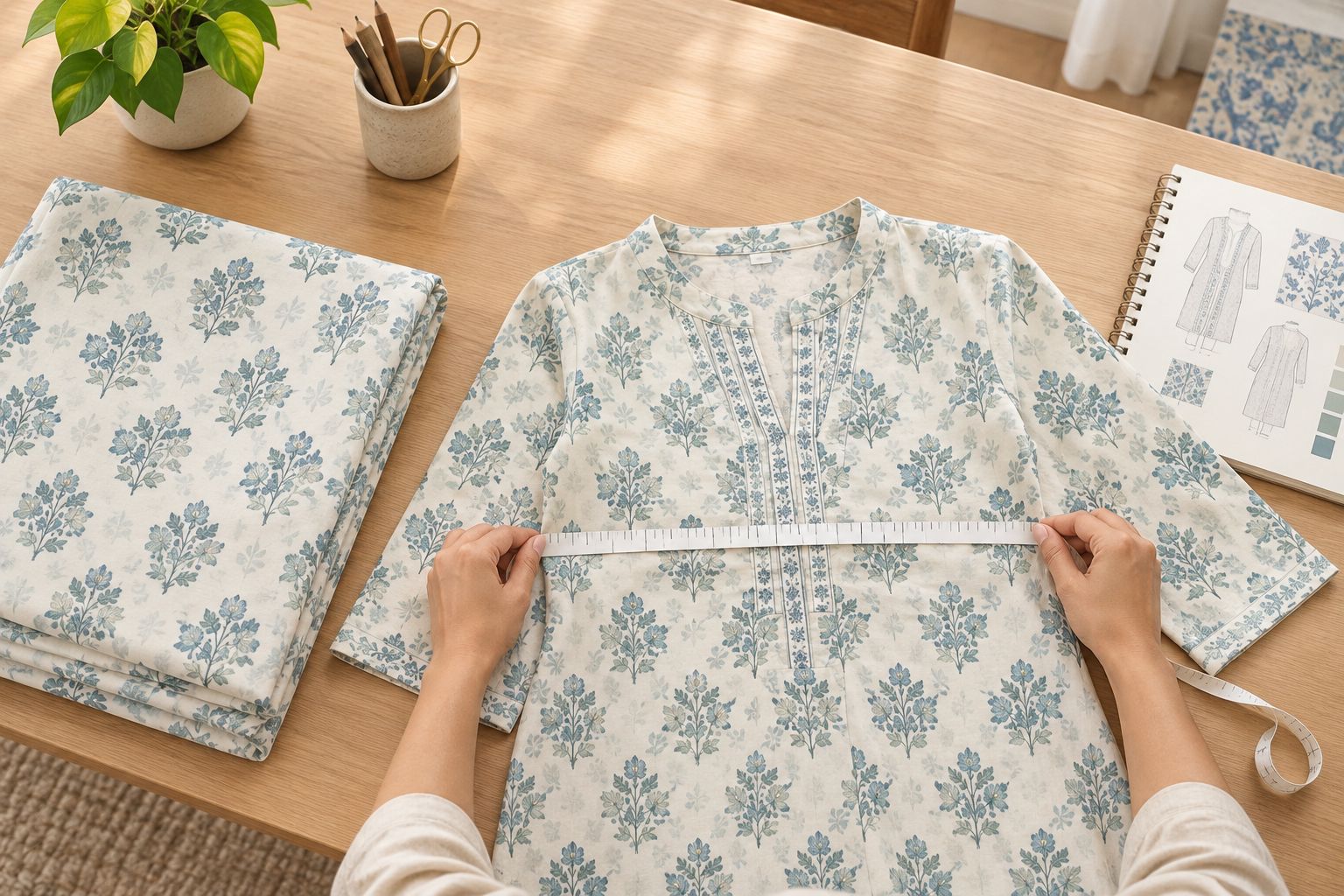
Take 2 reference photographs: the garment laid flat and a detail of any fit feature you want to retain. Photographs support your written measurements; they do not replace them.
- Label body measurements and garment measurements separately.
- Record all measurements in the same unit.
- Show your tailor the intended neckline, sleeves and hem.
- Confirm the cutting layout before buying or cutting fabric.
Plan the print around the finished outfit
Spread the material out before deciding where the front, back and sleeves will sit. A print that looks balanced when folded can place a large flower or strong border awkwardly once cut. Directional motifs also need deliberate placement.
For office wear, think about the complete outfit rather than the top alone. A patterned kurta can work with a plain bottom you already own; a coordinated set needs a similar check for how its colours and patterns sit together. Neither small prints nor plain colours are compulsory for work.
Check the print at the neckline, centre front, side seams and sleeve ends. Where matching matters to you, ask your tailor whether the available fabric allows it without compromising fit.
- Identify whether the print has a clear direction.
- Mark the proposed front panel before cutting.
- Check border placement against your intended hem.
- Compare the material with your actual bottom and shawl.
Settle lining, ease and finishing details
Discuss the finished garment while the fabric is still uncut. Explain how you sit, travel and use your arms during work, then ask your tailor to translate those needs into suitable wearing ease. A loose-looking garment is not automatically comfortable at the shoulders or upper arms.
If lining is needed, check the outer fabric and proposed lining together. Consider opacity, feel and care compatibility rather than choosing an inner fabric by colour alone. A lining that pulls or hangs differently changes how the outfit sits.
Keep finishing details practical. Decide whether you need pockets, how a fastening will work and whether a decorative edge will touch your skin. These decisions are easier to make before stitching begins.
- Agree on ease at the chest, hips and upper arms.
- Test the outer fabric and lining together.
- Choose pocket placement around your daily use.
- Confirm neckline depth and fastening details.
- Check that side slits suit seated wear.
Confirm care before the first wash
Read the item-specific care instructions before prewashing. Do not assume every cotton fabric tolerates the same temperature, soaking routine or ironing setting, especially when a set includes different components or decorative details.
Cotton fabric can change dimension during washing, but the amount is not something to guess from a photograph. Ask whether the material has been pretreated and follow the seller’s instructions. Where washing before cutting is appropriate, let the fabric dry as directed before your tailor checks the layout again.
For your 2026 work wardrobe, choose a care routine your household can maintain. An outfit needing special handling is less useful if it repeatedly misses the next working day.
- Save the care instructions for the exact material.
- Confirm whether prewashing is advised before cutting.
- Check separate instructions for contrasting components.
- Dry and iron according to the stated guidance.
- Keep leftover fabric with the garment’s care notes.
Compare your workwear material options
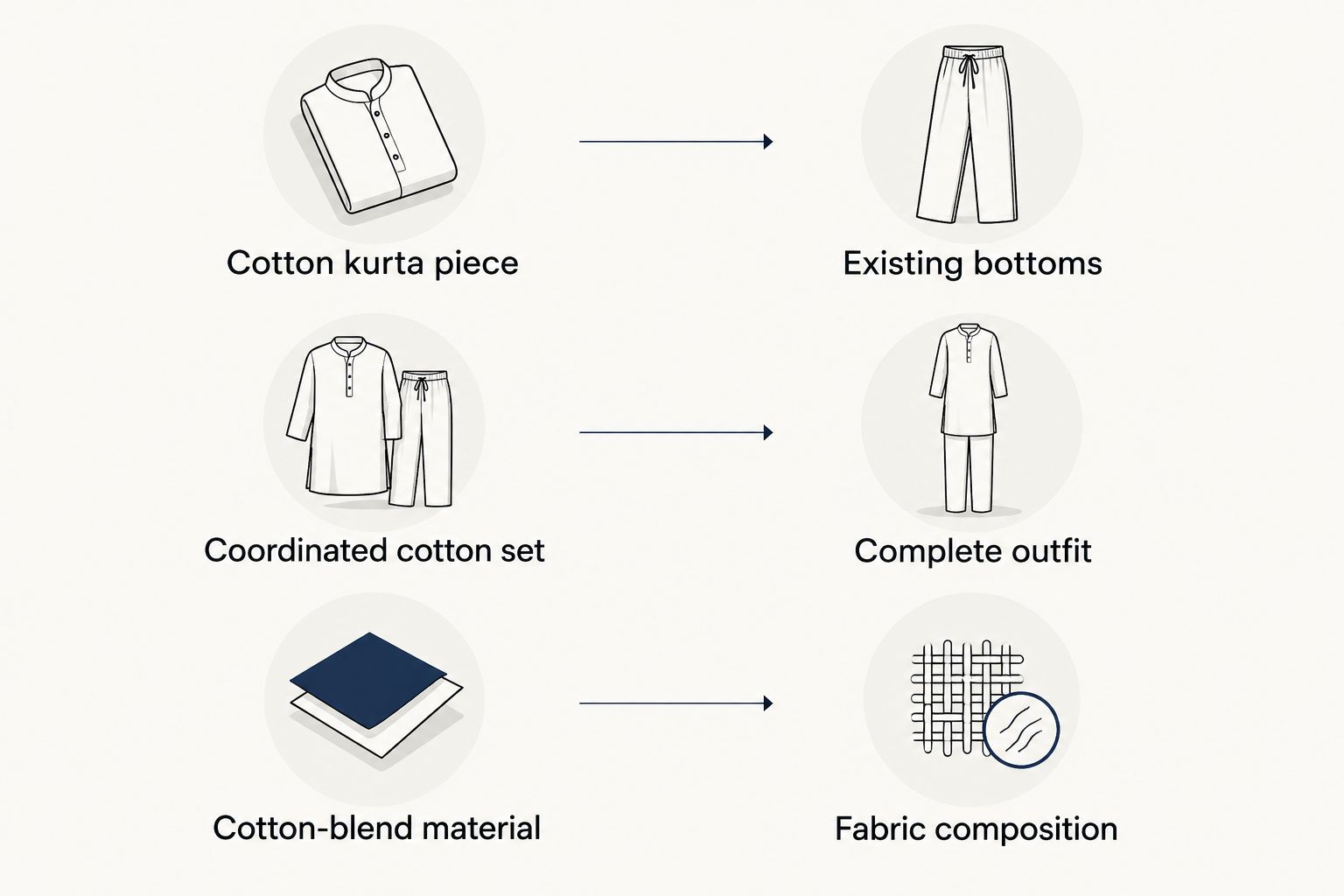
Choose the format that solves your wardrobe need, then check its limitations. This 2026 comparison concerns buying formats, not a ranking of fabric quality; the individual listing and your tailor’s assessment remain essential.
| Option | Best for | Main advantage | Key limitation |
|---|---|---|---|
| Cotton kurta piece | Pairing with existing bottoms | Lets you focus on the top you need | You must check matching and sufficient fabric separately |
| Coordinated cotton set | Planning a complete outfit | Brings the intended components together | Each component still needs composition and measurement checks |
| Cotton-blend material | Considering a specifically described blend | Offers another fabric composition to assess | The word blend does not establish feel, opacity or care |
| Cotton with lining | A design needing an additional inner layer | Lets you address coverage during construction | Adds another fabric and care decision |
The comparison starts with what you need to make, not which fabric looks most attractive folded. A coordinated set simplifies matching; it does not remove the need for a cutting plan.
Common mistakes working women make when buying dress material
Buying by colour before checking coverage
A colour that suits you does not answer whether the fabric needs lining. Settle opacity first, particularly for garments you will wear in daylight or near bright windows, and only then choose the final construction.
Reusing an old fabric-length estimate
A previous kurta’s fabric requirement is not a reliable cutting plan for a different width, sleeve shape or directional print. Give your tailor the new material details rather than ordering from memory.
Treating every part of a set as identical
The top, bottom and shawl serve different purposes. Check each component instead of applying the top’s stated composition, width or washing instructions to the whole set.
Copying a festive cut for everyday work
A sleeve or neckline you enjoy for a short celebration needs a separate movement check for work. Before final stitching, test reaching forward, sitting and wearing any shawl or dupatta as you intend to use it.
FAQ
What is the best cotton dress material for office wear?
The best cotton dress material for office wear meets your coverage, fit and care needs. Check composition, opacity, usable width and the proposed cutting plan rather than choosing by colour alone.
How much cotton dress material do I need for a work kurta?
Your required fabric length depends on garment measurements, usable width, sleeves and print placement. Ask your tailor to confirm the cutting plan for the exact material before ordering.
Is a cotton churidar material set better than buying a separate kurta piece?
A coordinated set is better when you want matching outfit components; a separate kurta piece is better when suitable bottoms are already in your wardrobe. Neither option removes the need to check measurements and care instructions.
Does cotton dress material always need a lining?
Cotton dress material does not always need a lining. Check transparency against your intended underlayer and discuss the finished garment with your tailor before deciding.
Should I wash cotton dress material before stitching?
Follow the exact material’s care guidance before washing it prior to stitching. Ask whether prewashing is advised and whether different components need separate handling.
Can I use printed cotton dress material for formal office outfits?
Printed cotton dress material can suit office outfits when the design meets your workplace requirements. Check motif placement, coverage and fit, then coordinate it with the bottom and any shawl you plan to wear.
What should I check when buying cotton dress material online in 2026?
Check the exact listing’s composition, component contents, dimensions and care instructions before buying cotton dress material online in 2026. Pulpel shoppers should clarify any missing details rather than infer them from product photographs.
One last thing
Your most useful buying reference is often already in your cupboard. Keep the measurements and fit notes from a comfortable work kurta, including anything you would change next time; that record turns browsing into a more focused decision.
Before cutting new fabric, compare the material, the notes and your tailor’s plan together. A familiar, comfortable fit is a stronger starting point than copying a photograph exactly.