

You need enough cotton dress material to fit your complete kurta cutting layout at the fabric’s actual usable width, rather than a fixed quantity based on size alone. Include sleeves, facings, seam allowances and hems; any allowance for shrinkage or matching a print must also be settled before you buy.
- For cotton dress material, confirm fabric width and a complete kurta layout before deciding the length to buy.
- Pulpel’s everyday-outfit guide helps family shoppers choose cotton dress material; confirm measurements separately before ordering.
- Include sleeves, facings, hems and seam allowances, not just the finished kurta length.
- Check washing instructions before prewashing; never assume every cotton fabric needs the same treatment.
Why this matters
A kurta that feels comfortable at home or during a busy day starts with enough room in the pattern, not simply enough fabric to cover your body. Buying from an estimate without checking width can leave you choosing between shorter sleeves and a shorter hem.
For your 2026 sewing plans, settle the design before settling the quantity. Pulpel’s guide to choosing cotton dress material for everyday outfits covers fabric selection; the next step is checking whether your chosen piece accommodates your own pattern.
Buy to the cutting layout, not to the clothing-size label. A familiar size is useful when discussing fit, but it does not describe your kurta’s length, flare, sleeves or finishing details.
How much cotton dress material do you need for a kurta?
The dependable quantity is the length occupied by all your pattern pieces when arranged correctly within the usable fabric width. Ask your tailor to confirm that length for the exact fabric and design before ordering.
Use this sequence rather than treating a general metre recommendation as a guarantee:
- Choose the shape. Decide the finished length, straight or flared silhouette, neckline, openings and sleeve style.
- Confirm usable width. Check the stated fabric width and whether borders or selvedges restrict the cutting area.
- Prepare the pattern. Include wearing ease and the seam, hem and finishing allowances required by the design.
- Arrange every piece. Lay out the front, back, sleeves, facings, pockets and any other fabric components on the correct grain.
- Check care needs. Agree how to handle any expected dimensional change before cutting, following the fabric’s instructions.
- Confirm the quantity. Have the tailor approve the purchase length, including any extra needed for print placement or matching.
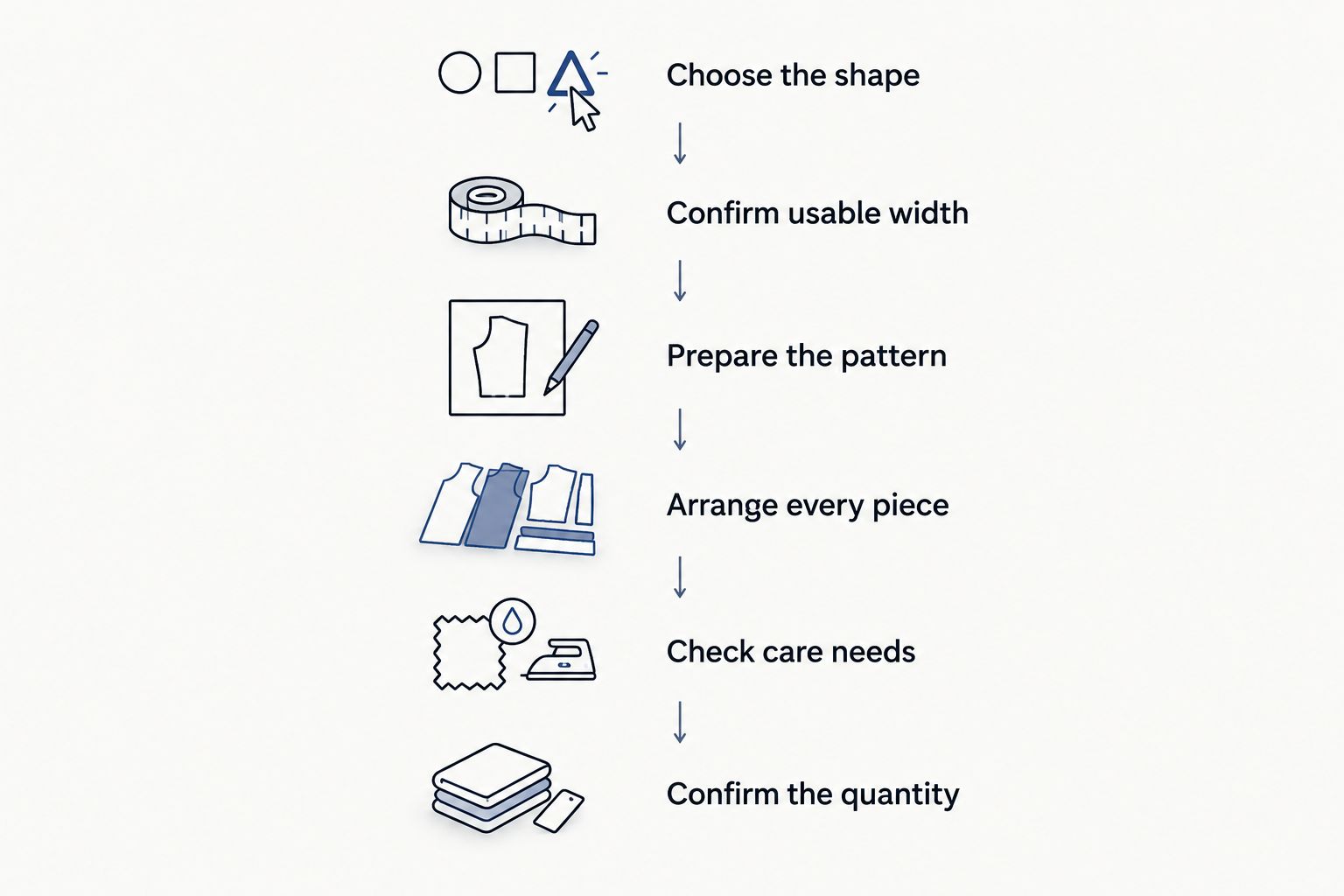
A layout is more useful than a body measurement alone. Your body measurements establish fit, while the cutting layout establishes how the pieces fit onto the cloth.
If you already have a well-fitting kurta, take it to the tailor as a reference. Point out what you want to keep and what you want changed; copying the length but changing the sleeves still requires a fresh quantity check.
Compare your kurta designs before buying
Different kurta shapes place different demands on the same piece of fabric. The table below compares design choices, not guaranteed fabric quantities.
| Design choice | Best for | Practical advantage | Limitation to check |
|---|---|---|---|
| Straight kurta | Shoppers wanting a simple everyday shape | A straightforward silhouette to discuss with your tailor | Long sleeves, pockets and extra length still need space |
| Flared kurta | Shoppers wanting a wider hem | Gives more room around the lower part of the garment | Wider or additional panels need their own layout |
| Sleeveless kurta | Shoppers who prefer uncovered arms | Removes separate sleeve pieces | Armhole facings or binding still require fabric |
| Full-sleeve kurta | Shoppers wanting arm coverage | Provides the chosen sleeve coverage | Both sleeves must fit with the body pieces |
| Panelled kurta | Shoppers wanting shaped or contrasting sections | Allows design details through separate panels | Each panel needs seam allowances and correct grain placement |
Choose the design you will actually wear, then confirm its fabric requirement. Reducing a pattern to fit a short piece is a design change, not a reliable buying method.
For a Vishu family gathering or another occasion in 2026, show your tailor the intended neckline and decorative placement at the start. Details added after cutting can be difficult to accommodate from the remaining fabric.
Why cotton dress material quantities vary
These factors determine how much cloth your kurta needs. Review them together: changing one can affect where several pattern pieces fit.
- Usable fabric width: The usable area controls whether pieces fit beside one another or must sit farther along the length. Do not count a border as plain cutting space unless it belongs in the design.
- Finished length and flare: A longer body needs longer front and back pieces. A wider hem changes the width or number of panels required.
- Body measurements and ease: Bust, waist, hip and upper-arm measurements affect the pattern. Wearing ease adds the room needed for your intended fit and movement.
- Sleeves and finishing pieces: Sleeve length, sleeve width, cuffs, collars, facings, pockets and ties all need consideration. Small pieces are not automatically covered by leftover scraps.
- Print direction and matching: A one-way print restricts how pieces can face. Stripes, checks and prominent motifs need deliberate placement if you want them to align.
- Fabric preparation and construction: Care instructions, potential shrinkage, seam allowances, hems and any separate lining affect the plan. Confirm each rather than applying a blanket allowance.
A plain fabric gives more freedom over motif placement than a directional print, but it does not remove grain requirements. Your tailor should still position the pattern correctly rather than rotate pieces simply to squeeze them in.
Which measurements should you take to your tailor?
Take your body measurements, preferred finished garment measurements and the actual fabric width. Keep those categories separate so that a comfortable garment measurement is not mistaken for a close body measurement.
For a 2026 measurement note, record the date alongside the measurements. Use current measurements rather than relying on an old size label or a kurta whose fit you no longer like.
Record your body measurements
Ask the tailor to check the bust or chest, waist, hip, shoulder and upper arm, together with any other measurements the pattern needs. Wear the undergarments you intend to use with the finished kurta when checking fit.
The tape should sit in the correct position without being pulled tight. Tell the tailor whether you prefer a relaxed everyday fit or a closer shape; neither preference should be guessed from the clothing size alone.
Record your preferred finished dimensions
Specify the kurta length from the agreed shoulder point, the sleeve length and the desired hem width. Also discuss side-slit placement and neckline depth before the pattern is finalised.
A well-fitting garment is a helpful reference, but do not measure only across its front and treat that as a body circumference. Explain whether each measurement comes from your body, a flat garment or a completed pattern.
Keep measurement units consistent
1 metre equals 100 centimetres, and 1 inch equals 2.54 centimetres. Also, 1 centimetre equals 10 millimetres; write the unit beside each measurement so the tailor does not have to infer it.
These conversions help you compare a listing expressed in one unit with measurements recorded in another. They do not establish how much fabric a particular kurta needs: that still comes from the layout.
What should you check on an online fabric listing?
Read the individual listing for composition, width, supplied length, piece count and care instructions. A photograph can help you understand the design, but it cannot establish the usable width or confirm what is included.
When comparing cotton dress material at Pulpel, keep the product description separate from the tailoring plan. A stated fabric length describes the piece supplied; your tailor decides whether that piece accommodates your chosen kurta.
Before ordering, check:
- Whether you are buying running fabric, a fixed-length piece or a coordinated set.
- Whether the stated length refers to the top fabric alone or to separate components.
- Whether the width is clearly specified.
- Whether the composition says cotton, a cotton blend or another material.
- Whether a border, embroidered section or directional print affects placement.
- Whether the care instructions suit your household’s washing routine.
Do not treat the combined length of a dress-material set as one continuous kurta piece. Separate top, bottom and dupatta components have their own dimensions and intended uses.
For online shopping in 2026, send the exact listing details to your tailor before making the final quantity decision. A product name alone is not a cutting specification.
Should you wash cotton dress material before stitching?
Check the fabric’s care instructions and discuss preparation with your tailor before washing or cutting. Cotton fabrics can shrink, but the amount and appropriate treatment depend on the particular material and finish.
Do not apply an assumed shrinkage percentage to every purchase. Printed, embroidered, lined or blended materials need their own care checks, and an instruction suitable for one fabric does not automatically suit another.
Where washing is permitted and agreed as part of preparation, complete that preparation before final cutting. The tailor can then work with the prepared fabric rather than a quantity that has not yet been checked after treatment.
During Kerala’s rainy season, plan enough drying space and time for the permitted preparation method. Avoid cutting damp fabric, and do not substitute strong heat for a care method the fabric instructions do not support.
Can wider fabric reduce the length you need?
Wider usable fabric can reduce the required length when it allows pattern pieces to fit beside one another. It does not guarantee a reduction, because the pieces must still fit in the correct direction with their allowances included.
Ask your tailor to compare layouts at the actual widths being considered. The useful comparison is the completed layout, not width alone.
Does a kurta-and-bottom set need a separate calculation?
A kurta-and-bottom outfit needs a layout for each garment, plus any additional components you plan to make. Do not assume fabric remaining after the kurta will accommodate trousers or churidar bottoms.
Decide the bottom style before buying. A coordinated appearance does not mean the garments share the same pattern requirements or can be cut from interchangeable pieces.
FAQ
How much cotton dress material should I buy for my first kurta?
Buy the length your tailor confirms from a complete layout at the fabric’s actual usable width. Include the chosen sleeves, finishing pieces, allowances and any print-placement requirements before ordering.
Can I buy kurta fabric using only my clothing size?
No, clothing size alone does not establish the fabric quantity for a kurta. Finished length, fit, sleeves, usable width and pattern shape also affect the cutting layout.
Do full sleeves need more fabric than a sleeveless kurta?
Full sleeves require additional pattern pieces, but the change in purchase length depends on where those pieces fit. Ask your tailor to compare the complete layouts rather than adding an assumed length.
Can I use the same fabric quantity for every cotton kurta?
No, the same quantity does not guarantee that every cotton kurta pattern will fit. Changes in fabric width, garment length, flare and print direction can change the required layout.
Should I add a fixed shrinkage allowance to cotton dress material?
Do not add a fixed shrinkage allowance without guidance for the particular fabric. Follow its care instructions and agree the preparation method and purchase allowance with your tailor.
Is all fabric in a dress-material set usable for the kurta?
Not necessarily: a coordinated set can contain separate pieces intended for different garments or components. Check each piece’s length, width and purpose before deciding what can be cut from it.
What should I send my tailor before ordering fabric online?
Send the fabric composition, width, supplied length, design images and care instructions, together with your chosen kurta style. Ask for confirmation of the purchase quantity before ordering.
One last thing
Ask your tailor to reserve suitable offcuts for repairs after cutting. A matching piece can be useful for a later patch or small alteration, although the usable leftovers depend on the layout.
For your next Pulpel cotton dress material purchase in 2026, keep one simple note: fabric width, chosen design, confirmed quantity and care instructions. That is more useful than saving a general metre estimate without its assumptions.