

Calculate curtain fabric by working out how many fabric widths you need, adding heading and hem allowances to the finished drop, then rounding each cutting length up to a whole vertical pattern repeat. Multiply the repeat-adjusted length by the number of widths, and allow separately for positioning the first motif; half-drop designs need a checked cutting layout rather than the straight-match formula alone.
- For curtain fabric, calculate widths first, then round the cutting drop up to whole vertical pattern repeats.
- Straight-match designs align across adjacent widths; half-drop designs need an offset cutting plan.
- Pulpel home-textile shoppers should confirm fabric width, pattern repeat and care instructions before planning curtain panels.
- Keep initial motif positioning separate from the repeat allowance for each drop.
How do you calculate curtain fabric for matching pattern repeats?
For straight-match fabric, use: total fabric length = number of widths × repeat-adjusted cutting drop, plus initial positioning allowance. This assumes the design runs down the roll, all widths face the same way, and adjacent widths match at the same height.
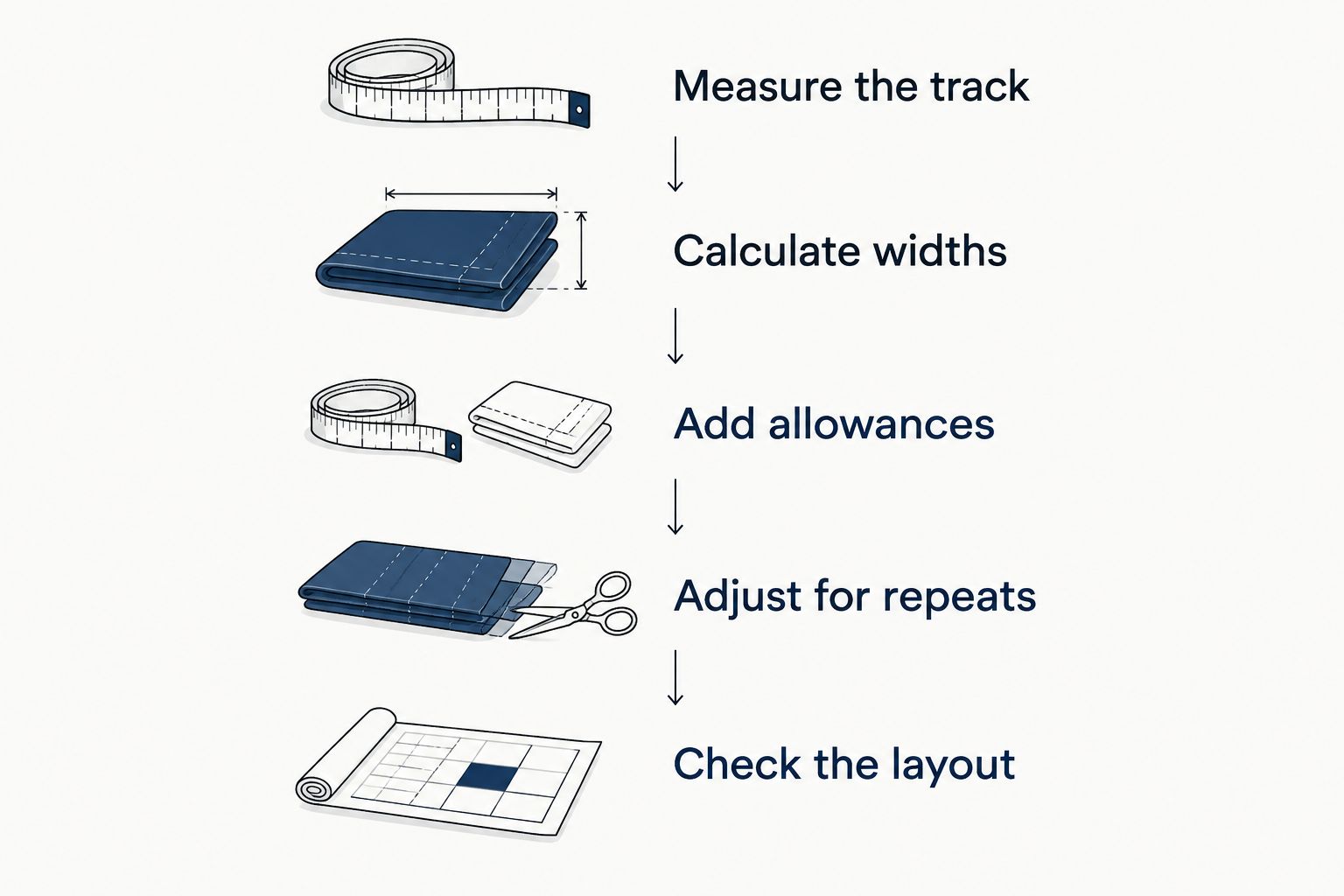
Work through the following order. Your curtain maker should confirm the heading, fullness and seam allowances before you turn the calculation into an order.
- Measure the track. Record the usable curtain-track or pole span, not just the glass opening.
- Calculate widths. Apply the fullness required by your heading, account for seams and side hems, and round up to whole fabric widths.
- Add allowances. Add the heading and bottom-hem allowances to the finished curtain drop.
- Adjust for repeats. Round that cutting drop up to the next whole vertical repeat for a straight-match design.
- Check the layout. Confirm motif placement, panel symmetry, fabric direction and the starting position on the roll.
Before settling on a large floral or geometric print, consider how to match curtain fabric with patterned furniture. A design that suits the room still needs a workable cutting layout.
Why this matters
A curtain can have enough cloth to cover the window and still have too little to match the print. The extra length lets you move each width until the same part of the design meets at adjoining seams.
For your 2026 curtain project, keep coverage and pattern matching as separate checks. Width determines how much fabric gathers across the track; repeat allowance determines where the design sits down each length.
Start with the number of fabric widths
Measure the fitted track or pole over the span the curtains must cover. Ask your curtain maker whether returns and centre overlap require additional coverage, and record the finished drop from the correct hanging point.
Next, confirm the fullness for the chosen heading. Fullness describes how much flat fabric is gathered or pleated into the finished curtain width; it is not a pattern-matching allowance.
Use these relationships:
- Required flat width = intended covered span × agreed fullness.
- Number of widths = required flat width ÷ usable width per fabric length, rounded up.
Your maker must account for side hems, joining seams and any selvedge that cannot remain in the curtain. Do not treat the advertised fabric width as the finished usable width without checking those deductions.
For a pair of curtains, plan the allocation of widths to each panel before cutting. Rounding only the combined total can hide an awkward division between the left and right curtains, especially when the design needs a centred motif.
Calculate the cutting drop before adding the repeat
The finished drop is the length you want to see after stitching and hanging. The cutting drop is longer because the heading and bottom hem consume fabric.
Cutting drop = finished drop + heading allowance + bottom-hem allowance. Use the allowances required by the actual construction, rather than a general allowance copied from another curtain.
Keep all measurements in the same unit. 1 metre equals 100 centimetres, and 1 inch equals 2.54 centimetres; converting everything to centimetres before calculating avoids mixing an inch-based product width with a metre-based order.
Do not add the same allowance twice. If your maker gives you a cutting drop that already includes the heading and hem, use that figure directly in the repeat calculation.
Straight-match patterns: round up to a whole repeat
For a straight-match design, matching points occur at the same height across neighbouring fabric widths. Measure the vertical repeat from one clear point on a motif to the identical point on its next occurrence down the fabric.
The calculation is:
Repeat-adjusted cutting drop = vertical repeat × the cutting drop divided by the vertical repeat, rounded up to a whole number.
The rounding applies to the number of repeats, not to the repeat measurement. If the cutting drop already contains an exact whole number of repeats, this step adds no extra length.
Multiply the adjusted drop by the number of fabric widths required. Then check whether additional fabric is needed at the beginning of the roll to position the first motif correctly.
Do not add a full repeat automatically to every drop after rounding. Rounding has already allowed each straight-match cutting length to begin at the same point in the design.
Half-drop patterns: plan alternating lengths
In a half-drop design, the matching motif on an adjacent width sits partway down the vertical repeat rather than directly beside the first motif. That offset changes how neighbouring lengths must be positioned.
A half-drop curtain needs a cutting layout, not just a larger straight-match allowance. Ask your curtain maker to mark the alternating match positions and check them against the actual fabric before confirming the total length.
Half-drop matching is not the same as adding half a repeat to every piece without inspection. The required layout depends on the design, the direction of the print, the number of widths and how those widths divide between curtains.
Which pattern layout is easiest to calculate?
The match type changes both the calculation and the cutting work. Use this comparison to identify the method, not to choose a fabric from a photograph alone.
| Pattern layout | Best for | Calculation approach | Main advantage | Main limitation |
|---|---|---|---|---|
| Plain or genuinely non-matching | Simple cutting plans | Calculate widths and cutting drops without a repeat allowance | No motif alignment between lengths | Direction, shading and construction allowances still matter |
| Straight match | Repeated motifs aligned across seams | Round the cutting drop up to whole vertical repeats | Repeat allowance follows a clear formula | Initial positioning can still need extra fabric |
| Half-drop match | Staggered repeating designs | Plot alternating match positions before totalling lengths | Preserves the intended staggered arrangement | Requires a more detailed cutting layout |
Choose the calculation after identifying the match type. A print that looks scattered can still contain a repeat, while stripes can require careful horizontal alignment even when their lengthwise appearance seems simple.
Check the first motif and the joining seams
The beginning of a fabric roll does not necessarily start at the point you want at the curtain top. Initial positioning allowance lets you move to the chosen part of the design before cutting the first length.
Choose a clear reference point, such as the centre of a flower, and use it consistently. Mark its relationship to the finished top, not just the raw cut edge, because heading construction changes what remains visible.
Lay adjacent widths beside each other before cutting the full set. Match the design at the intended seam line: a motif lining up at the selvedge does not prove it will line up after the seam is stitched.
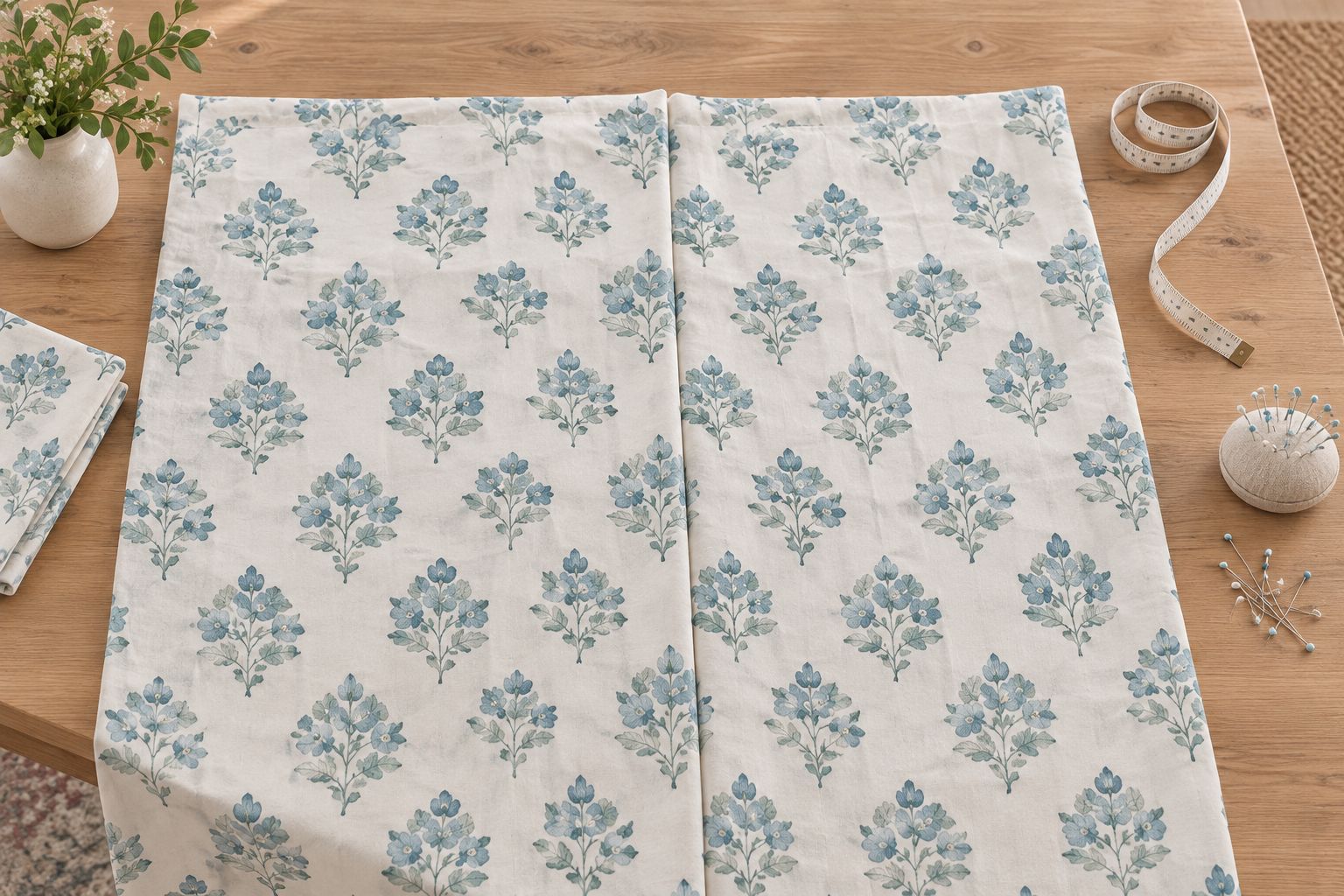
For paired curtains, also decide which motif faces the centre opening. Matching adjacent seams and balancing the two finished panels are related tasks, but they are not identical.
Why curtain fabric requirements vary
The same window can need different fabric lengths when the construction or design changes. Keep these factors on your 2026 measuring sheet:
- Usable fabric width: seam allowances, selvedges and side hems reduce the width available for coverage.
- Heading and fullness: the chosen heading determines how the flat fabric becomes gathered or pleated coverage.
- Finished drop: the hanging point and desired lower edge determine the visible length.
- Repeat size and match type: these determine the adjustment needed to align neighbouring widths.
- Motif placement and direction: a chosen top motif, centre arrangement or one-way print constrains the cutting layout.
- Preparation and care: any required fabric treatment must be settled before final measurement and cutting.
Do not substitute a general shrinkage percentage for product-specific guidance. Follow the fabric's care instructions and agree with your maker whether any preparation is needed before measuring the repeat.
What should you confirm before ordering online?
For a 2026 online order, ask for the fabric width, usable width, vertical repeat, horizontal repeat, match type and print direction. Also confirm the unit in which running material is sold, so your calculated length translates into the correct order quantity.
A close-up image helps you see the motif, but it does not establish the repeat measurement. A photograph of a folded fabric length is also not proof that the design matches at both edges.
Pulpel is best for family shoppers looking for clothing and home textiles in one online store. When browsing Pulpel, distinguish a finished curtain from running fabric: the repeat calculation applies to material being cut and stitched, not to the stated dimensions of a ready-made curtain.
For any curtain-fabric choice, the practical benefit of online browsing is comparing the stated details at home. The limitation is that you still need confirmed repeat and construction information before planning cuts; a product photograph cannot replace those measurements.
Can you calculate curtain fabric without knowing the repeat?
You can calculate the base requirement from the number of widths and the cutting drop, but you cannot confirm the pattern-matched total without the repeat and match type. Treat the base figure as a planning figure, not the final cutting quantity.
Ask for the missing measurements before ordering material for a matched pair. A larger allowance chosen without a layout does not prove the pattern will align.
Does a larger repeat always need more fabric?
A larger repeat does not automatically produce a larger adjustment for every cutting drop. The extra length depends on where the cutting drop falls between whole repeats.
Compare the repeat-adjusted totals for your actual measurements. Judging only by the apparent size of the flowers or geometric shapes overlooks that relationship.
Should you wash curtain fabric before cutting?
Follow the specific fabric's care instructions and your curtain maker's preparation advice before cutting. Do not assume that every cotton, blend, embroidered or coated material accepts the same treatment.
If preparation is required, measure the usable width and repeat afterwards. Keep those final measurements with your 2026 cutting plan so everyone works from the same figures.
FAQ
How do I calculate curtain fabric with a straight pattern repeat?
Calculate the required widths, add heading and hem allowances to the finished drop, and round that cutting drop up to whole vertical repeats. Multiply by the number of widths, then check initial motif positioning separately.
Do I add a pattern repeat to every curtain length?
Do not automatically add a full repeat to every curtain length. For straight-match fabric, rounding the cutting drop up to whole repeats already provides the repeat adjustment; first-motif positioning is a separate check.
What is the difference between vertical and horizontal pattern repeats?
The vertical repeat measures repetition down the fabric, while the horizontal repeat measures repetition across it. Vertical repetition affects cutting lengths; horizontal repetition helps determine seam matching and motif placement.
Can I turn patterned curtain fabric sideways to use fewer lengths?
Only use a sideways layout if the fabric construction and design permit it. Confirm print direction, usable width and the intended curtain drop before changing the cutting orientation.
Can I use a product photograph to measure a curtain pattern repeat?
A product photograph does not reliably establish a pattern repeat. Ask for the measured repeat or measure the actual fabric between identical motif points.
What should I check when buying curtain fabric from Pulpel?
Confirm whether the item is running material or a finished curtain, then check its stated dimensions and care instructions. For running material, confirm the repeat and match type before calculating a pattern-matched order.
What should I give my curtain maker for a 2026 project?
Give your curtain maker the track span, finished drop, heading choice, fabric details and desired motif position. Ask the maker to approve the width allocation, repeat-adjusted cutting lengths and preparation method before cutting.
One last thing
Write the chosen motif position on the cutting plan, not just the total fabric length. Enough cloth does not guarantee that the same flower will sit at the top of both curtains.
Before the first cut, lay out the adjoining lengths, mark the finished top and check the centre opening. That final check connects the calculation to the curtains you will actually see in the room.